What is comprehensible input (i+1)?

You pick up a language by understanding messages in it. Not by memorizing rules. Comprehensible input is stuff in your language that you mostly get. The "i+1" part means your level, plus a little.
What does that actually mean?
The idea comes from Stephen Krashen, a linguist. You watch a show in your target language. You don't know every word, but you follow the story: the faces, the tone, what just happened. Your brain is quietly working out the words and the grammar in the background while you just enjoy it.
That's the whole trick. You don't get there by analyzing. You get there by understanding.
What's i+1?
i is where you are now. +1 is one small step past it.
- Too easy (i+0). You understand everything. Comfy, but you're not growing much.
- Too hard (i+5). You understand almost nothing. It's noise. You zone out.
- Just right (i+1). You get most of it, and the rest you can guess from context. That's where you grow.
It moves, too. Something that was i+5 three months ago can be i+1 today. That's the fun part.
How do I find i+1 stuff?
- Pick things with pictures. Vlogs, dramas, anime, cooking videos. What you see carries what you don't hear yet.
- Pick things you already know. A show you've seen in your own language, a kids' cartoon, a game you've played. You know the story, so the words have somewhere to land.
- Use subtitles when you need them. Subtitles in your target language help you match the sounds to the words. In Aim that's its own activity, Active Subtitles.
- Pick what you'd watch anyway. If it bores you, you won't last. Finding what grips you is half the game.
Aim helps here. Your blueprint has an Immersion Library with my picks to watch, listen to and read in your language, and it's free. See How do I find things to watch, listen to and read?. With Pro, the Library page has hundreds more, and you can filter them by Difficulty (Beginner, Intermediate or Advanced) or sort them Difficulty: Easy → Hard. See How do I use the Library?.
How do I know if something is i+1 for me?
Ask yourself after you watch it. Aim does that for you. When you tick something off or log it, How did it go? asks How much did you understand?: Lost, Hard, Okay, Good or Easy. It's optional, but it's worth one tap.
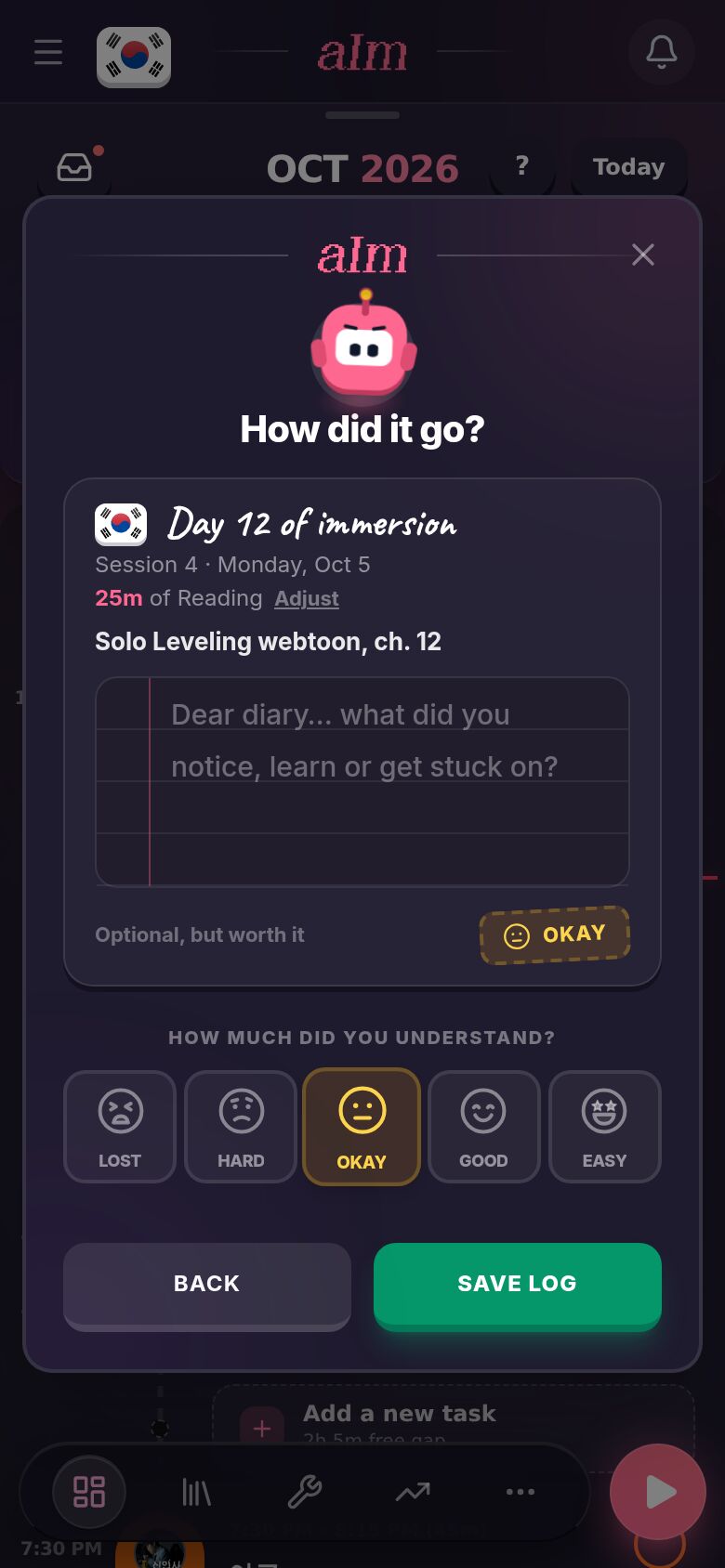
- Lost, every time? Go a step easier for now. Come back to it later.
- Hard or Okay? That's your zone. Keep going.
- Easy, every time? Push it. Find something a little harder.
Then the best part: come back to the same thing a month later and rate it again. Hard turns into Okay. Okay turns into Good. That's real proof you're getting somewhere. See How do I look back at old sessions and revisit one?.
Does it all have to be full focus?
No. Active time is full focus: you're watching, reading, really following. Passive time is your language playing in the background while you do the dishes or ride the bus. Active builds the most. Passive keeps your ears in it and fills the dead time. Aim tracks both. See How do I track passive listening?.
Good to know
- Not every word. You don't need to understand every word. You need to follow what's going on.
- Learning still helps. Flashcards and a bit of grammar make more things comprehensible, faster. They just aren't where fluency lives. See What's the difference between learning and acquiring a language?.
- The rating is about you, not the content. The same video can be Lost for one person and Easy for another. Rate how it went for you.