Tones and characters make Mandarin long. Input carries more of the load than you think.
Mandarin has a reputation for being impossible. It isn't, but it is long. This guide sets out the stages from zero to following Chinese dramas, YouTube and novels, the mix of the nine activities at each stage, real channels, podcasts and books for every level, and how to deal with tones, characters and the choice between simplified and traditional.
The answer
To learn Mandarin through immersion, spend most of your time listening to and watching Mandarin you can mostly follow: comprehensible input channels and slow podcasts at the start, then interviews, family sitcoms and dramas with Chinese subtitles, then native YouTube, podcasts and novels with no help. Learn pinyin and the tones in your first weeks, read graded readers early, and keep daily flashcards for characters and words.
It's a long project. The US State Department's Foreign Service Institute puts Mandarin in Category IV, its hardest group for English speakers: 88 weeks and 2,200 class hours for its students to reach a 3 in speaking and listening. Immersion learners usually need a few thousand hours before native TV feels easy, so the mix of what you do in those hours matters as much as the total.
What Mandarin immersion looks like day to day
Immersion means Mandarin is what you watch, listen to and read in the time you already have. At the middle stage that might be an episode of a family sitcom with Chinese subtitles after dinner, a Mandarin podcast on the commute, 15 minutes of Anki for characters, and a chapter of a graded reader before bed.
Mandarin has one advantage for immersion learners: Chinese TV, variety shows and many YouTube videos come with Chinese subtitles on screen. Once you can read a few hundred characters, almost everything you watch is also reading practice.
- Mostly understandable. If you follow less than half of something, drop down a level
- A lot of it. Passive listening counts, kept apart from the hours you followed closely
- Things you like. Food, tech, history, dramas, games: Bilibili and YouTube have Mandarin creators for all of it
How long it takes, honestly
FSI's 88 weeks are full-time classroom training: 2,200 class hours plus self-study (FSI describes a typical week as 23 hours in class and 17 of self-study). On your own, expect the same order of magnitude: a few thousand hours of input before native shows and podcasts feel comfortable.
Two learners with 1,000 hours can be far apart. Hours of background audio before your ears know the tones build less than hours with content you follow closely. Count everything, but look at what it was made of.
| A day of | 1,000 hours | 3,000 hours |
|---|---|---|
| 1 hour | About 2 years 9 months | About 8 years |
| 2 hours | About 16 months | About 4 years |
| 4 hours | About 8 months | About 2 years |
The stages, and the mix of the nine activities at each
Hours are one-dimensional. The mix of the nine activities (Active Listening, Passive Listening, Active Subtitles, Reading, Study, SRS, Speaking, Writing, Shadowing) is what makes your 1,000 hours different from someone else's. The hour ranges are rough guides for an English speaker, not gates.
Mandarin is the one language where a little Shadowing pays from the start: copying a speaker's tones right after them trains your ear and your mouth together.
| Stage | Rough hours | Where you are | Aim for this mix |
|---|---|---|---|
| 1. Tones, pinyin and first words | 0 to 60 | You hear the tones some of the time, know a few hundred words, follow videos with pictures | Active Listening 35%, Study 25%, SRS 20%, Passive Listening 15%, Shadowing 5% |
| 2. Learner content | 60 to 400 | Comprehensible input and slow podcasts make sense; graded readers work with help | Active Listening 40%, Passive Listening 20%, SRS 15%, Reading 15%, Study 10% |
| 3. Native content with Chinese subtitles | 400 to 1,800 | You follow sitcoms, interviews and easier dramas, reading the on-screen subtitles as you go | Active Subtitles 30%, Active Listening 20%, Passive Listening 20%, Reading 15%, SRS 10%, Shadowing 5% |
| 4. Native content without help | 1,800 and up | Dramas, podcasts and YouTube at full speed; novels and the news | Active Listening 30%, Reading 25%, Passive Listening 15%, Speaking 15%, Writing 10%, Shadowing 5% |
What to watch, listen to and read at each stage
Every pick below is in Immersed's curated Mandarin library or its index of Mandarin creators. Move on when something feels easy, not when you've finished it.
| Stage | Watch | Listen | Read |
|---|---|---|---|
| 1. Tones, pinyin and first words | Lazy Chinese (comprehensible input), Unconventional Chinese with Keren, Little Fox Chinese stories | The audio of the same channels; Mandarin Monkey for a gentle mix | Du Chinese at its easiest levels, with pinyin on |
| 2. Learner content | Mandarin Corner interviews with Chinese subtitles, Easy Mandarin street interviews, the CCTV series Happy Chinese | Speak Chinese Naturally, Learning Chinese Through Stories | Mandarin Companion graded readers, The Chairman's Bao |
| 3. Native with Chinese subtitles | The family sitcom 家有儿女 (Home with Kids), Meteor Garden (流星花园) on Netflix, the family drama 以家人之名 (Go Ahead), explainers by 小Lin说, cooking with Chef Wang 美食作家王刚 | The interview podcast 咸柠七, Learn Taiwanese Mandarin Podcast | Manhua on Bilibili Manga, Du Chinese at its harder levels |
| 4. Native without help | 一席 YiXi talks, dramas on iQIYI and Tencent Video, films from the Douban Top 250 | Shows found on 小宇宙 or Ximalaya, 张潇雨's 得意忘形 | 活着 (To Live) by 余华, BBC News 中文, Zhihu answers, web novels on Qidian |
Mandarin's specific hurdles
Mandarin's hurdles are well known. Most of them get smaller with input; a couple need a little deliberate work.
- Tones. Standard Mandarin has four main tones and a neutral tone on weak syllables, and they change meaning. Train your ear early with a tone trainer and short shadowing, then let thousands of hours of listening make them automatic. Don't wait to hear them perfectly before you start listening: listening is how you come to hear them
- Characters. There's no reliable link between how a character looks and how it sounds, so reading is its own project. Learn characters through words you meet in content, with SRS, and lean on pinyin only at the start
- Simplified or traditional. Mainland China uses simplified characters; Taiwan and Hong Kong use traditional. Pick the one that matches the content you love and start there. The other comes much faster once you know one
- Homophones. Many syllables share a sound. Context, and the on-screen subtitles on most Chinese TV, sort them out
- Accents. Standard Mainland speech, Taiwanese Mandarin, the Beijing 儿 sound and southern accents all sound different. Pick a 'language parent', one speaker whose Mandarin you'd like to sound like, and listen to them a lot: Mandarin Corner or 咸柠七 for standard Mainland speech, a Taiwanese creator for Taiwan's
- Measure words and set phrases. Every noun has a counter, and educated speech is full of four-character idioms (成语). Both come from reading and listening far more than from lists
The tools that help
This is the Mandarin kit Immersed hand-picks for the free blueprint. Each does one job; none replaces the hours.
- Migaku (or Language Reactor): click words in Netflix and YouTube subtitles and save them with audio and the sentence. See Immersed vs Migaku
- Anki: free spaced-repetition flashcards for the words and characters you meet. Ten to twenty minutes a day. See Immersed vs Anki
- [Pleco](https://www.pleco.com): the essential Chinese dictionary app. Use handwriting and camera lookup for characters you can't type
- MDBG: a fast Chinese-English dictionary on desktop
- Zhongwen: a pop-up dictionary extension; hover a character to see pinyin and meaning
- [Chinese Grammar Wiki](https://resources.allsetlearning.com/chinese/grammar/): every grammar point sorted by level. Look a pattern up after you've heard it a few times
- Tone Trainer: practise telling the tones apart until you score 90% or more consistently
- DeepL and Google Translate: check a sentence you half understood, then read the Chinese again
- For output: italki for conversation once you understand a lot, HelloTalk for exchanges, LangCorrect for free writing corrections
- [The listening games](/games/listening): free, no account. Mandarin has six: Numbers, Time, Years, Colors, Animals and Fruits, with all-time leaderboards. Hearing numbers fast is where tones get tested
How to track your Mandarin
Record every session as it happens: which of the nine activities, the actual show, channel or book, the minutes, and how much you understood. Rewatch an episode from two months ago and rate it again: in Mandarin, the jump in comprehension is often the most motivating number you have. The full method is in how to track your language immersion.
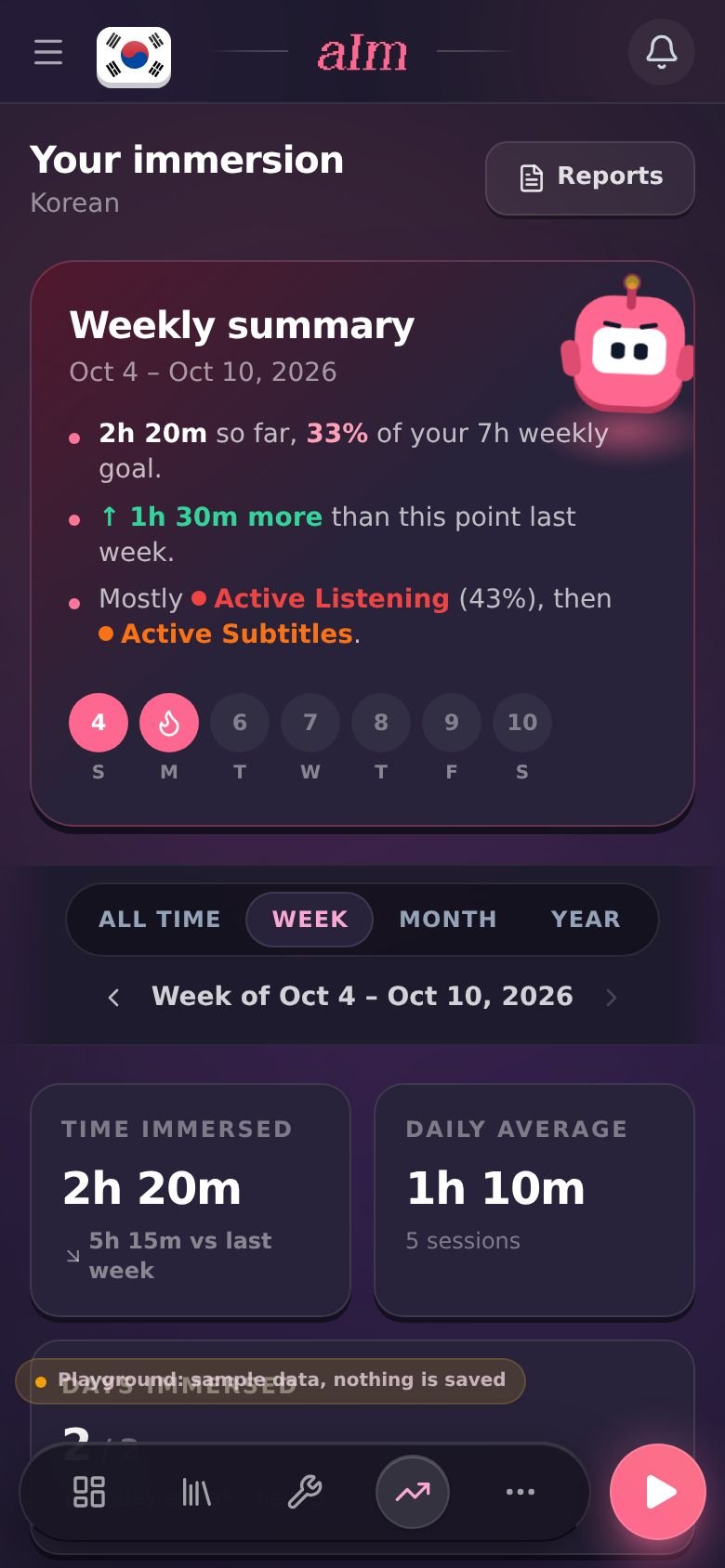
Immersed is a language immersion tracker and planner. It turns immersion into something you can see, plan and keep: a free plan built from your answers, a daily timeline for the shows, podcasts and books you learn from, and reports of your hours. The blueprint is free, with no account (it asks for your name and email): your plan, Hidden time in your day, the five-tool Mandarin Toolkit above, Library picks and the Foundations of the Fluency Checklist, as a PDF too.
Immersed Pro ($9.99 a month, or $60 a year with a 7-day free week) is the daily part: the timeline, sessions with the nine activities and a comprehension rating, the full Mandarin Library, Discover's feed of Mandarin creators and podcasts, Growth reports stacked by activity with your top shows linked, monthly Sprints and streaks. Immersed never reads your viewing history: every session starts with a press. Learning Cantonese instead? See how to learn Cantonese through immersion. Build your free blueprint.
FAQ
Questions people ask.
How long does it take to learn Mandarin through immersion?+
Years. The State Department's Foreign Service Institute puts Mandarin in Category IV, its hardest group for English speakers, at 88 weeks and 2,200 class hours for its students. Immersion learners usually need a few thousand hours before native TV feels easy: at two hours a day, around four years for 3,000 hours.
Can you learn Mandarin tones through immersion?+
Mostly, yes, with a little help at the start. A few minutes a day of tone training and shadowing in your first months teaches your ear what to listen for. After that, thousands of hours of listening do most of the work. Learners who skip listening and only study tones on paper tend to struggle more.
Should I learn simplified or traditional characters?+
Learn the set used by the content you want to enjoy. Simplified for mainland dramas, Bilibili and most Mandarin YouTube; traditional for Taiwan's shows and creators. Once you read one set well, the other comes quickly.
What should a beginner watch to learn Mandarin?+
Comprehensible input channels like Lazy Chinese and Unconventional Chinese, where everything is in Mandarin but made easy with pictures and gestures. After a few hundred hours, Mandarin Corner's interviews and family sitcoms like 家有儿女, which have Chinese subtitles on screen.
Do Chinese dramas have Chinese subtitles?+
Most do. Mainland and Taiwanese TV usually show Chinese subtitles on screen, which makes dramas and variety shows good reading practice once you know a few hundred characters. Watch with the Chinese subtitles and turn off any English ones.