Korean takes thousands of hours. What you do in them decides how many.
This is the method I used to learn Korean from my room in Maryland, before I ever set foot in Korea: real Korean at the right level, the nine activities in the right mix for each stage, and every hour on the record. It names the channels, dramas, podcasts, webtoons and books to use at each stage, and the tools that help.
The answer
To learn Korean through immersion, spend most of your time watching, listening to and reading Korean you can mostly follow: learner videos with pictures at the start, then web dramas, easy K-dramas and webtoons with Korean subtitles, then native YouTube, podcasts and novels with no help. Learn Hangul in your first week, keep a little study and 10 to 20 minutes of flashcards on the side, and let content do most of the teaching.
It takes a long time. The US State Department's Foreign Service Institute puts Korean in Category IV, its hardest group for English speakers: 88 weeks and 2,200 class hours for its students to reach a 3 in speaking and listening. Immersion learners usually put in a few thousand hours before native TV feels easy. At two hours a day that is years, not months, so how you spend the hours matters as much as how many you have.
What Korean immersion looks like day to day
Immersion isn't moving to Seoul. It's making Korean the thing you watch, listen to and read in the time you already have. A day at the middle stage might be a web drama episode with Korean subtitles at lunch, a Korean podcast on the commute, 15 minutes of Anki, and a few chapters of a webtoon before bed.
Three rules carry most of the method. The content has to be mostly understandable, or it's noise. There has to be a lot of it, every day. And you have to like it, because you'll be doing this for years. Everything else, from grammar to speaking, fits around those three.
- Input first. Listening and reading build the base. Speaking and writing grow out of it
- Right level. If you follow less than half of something, drop down a level and come back in a month
- Every day. Forty minutes on five days beats four hours on a Sunday
How long it takes, honestly
FSI's numbers are for classroom training: 2,200 class hours over 88 weeks, with self-study on top (FSI describes a typical week as 23 hours in class and 17 of self-study). Its students have teachers all day. An immersion learner on their own should expect the same order of magnitude: a few thousand hours before dramas, variety shows and podcasts feel comfortable.
That sounds like a lot until you do the arithmetic for your own day. Passive listening on the commute, at the gym and while cooking counts as hours too, as long as you keep it separate from the hours you followed closely.
Treat these numbers as rough. Two learners with 1,000 hours can be far apart: one spent them on content at the right level with full attention, the other on background audio and flashcards. That's why the mix in the next section matters.
| A day of | 1,000 hours | 3,000 hours |
|---|---|---|
| 1 hour | About 2 years 9 months | About 8 years |
| 2 hours | About 16 months | About 4 years |
| 4 hours | About 8 months | About 2 years |
The stages, and the mix of the nine activities at each
Hours are one number. What you did in them is the thing. These four stages use the same nine activities every serious tracker uses (Active Listening, Passive Listening, Active Subtitles, Reading, Study, SRS, Speaking, Writing, Shadowing), and the mix shifts as you go. The hour ranges are rough guides for an English speaker, not gates.
Active Subtitles means watching with Korean subtitles, not English ones. English subtitles turn a drama into a reading exercise in English. If you can't follow without English yet, the content is too hard for now: go back a stage rather than reach for the translation.
| Stage | Rough hours | Where you are | Aim for this mix |
|---|---|---|---|
| 1. Hangul and first words | 0 to 50 | You read Hangul slowly, know a few hundred words, follow learner videos with pictures | Active Listening 40%, Study 25%, SRS 20%, Passive Listening 15% |
| 2. Learner content | 50 to 300 | Comprehensible input channels and slow podcasts make sense; native speech is still a wall | Active Listening 45%, Passive Listening 20%, SRS 15%, Reading 10%, Study 10% |
| 3. Native content with Korean subtitles | 300 to 1,500 | You follow web dramas, easy K-dramas and webtoons, and miss plenty of words | Active Subtitles 30%, Active Listening 20%, Passive Listening 20%, Reading 15%, SRS 10%, Shadowing 5% |
| 4. Native content without help | 1,500 and up | Dramas without subtitles, podcasts at full speed, novels | Active Listening 30%, Reading 20%, Passive Listening 20%, Speaking 15%, Writing 10%, Shadowing 5% |
What to watch, listen to and read at each stage
Every pick below is in Immersed's curated Korean library. Start at the top of your stage and move on when something feels easy, not when you've finished it.
| Stage | Watch | Listen | Read |
|---|---|---|---|
| 1. Hangul and first words | Comprehensible Korean (whiteboard stories), KIWI: Korean Input with Images, 몰입한국어 Immersion in Korean | TTMIK Iyagi, beginner series (transcripts available) | Storybooks Canada in Korean, free children's picture books |
| 2. Learner content | 몰입한국어 at its intermediate end, Learn Real Korean, the cartoon Hello Jadoo, We Bare Bears dubbed in Korean | TTMIK Iyagi, intermediate series; the audio of 외국인을 위한 한국어 읽기 on Naver Audioclip | 외국인을 위한 한국어 읽기 (folktale readers for learners); the easy webtoons 대학일기 and 공감.jpg |
| 3. Native with Korean subtitles | Web dramas from 짧은대본 ShortPaper, PLAYLIST Originals and tvN D STORY; easier dramas like Another Miss Oh, Thirty But Seventeen and Meow, the Secret Boy on Viki or Netflix | 링톡 on 팟빵 (two Koreans on learning languages), the talk show 수다녀들, the hidden-camera skits of 낄낄상회 | 치즈 인 더 트랩 and 스위트홈 on Naver Webtoon; the 10-book Sherlock Holmes series for Korean children |
| 4. Native without help | 백종원 PAIK JONG WON (cooking), EBS 다큐, KBS News, 세바시 talks, films like 광해 (Masquerade) | Any show on 팟빵 or Naver Audioclip, VOA Korean radio, horror and story channels like 심야서점 | 아몬드 (Almond) by 손원평, essays on Brunch, Namu Wiki pages on things you like |
What it looked like for me
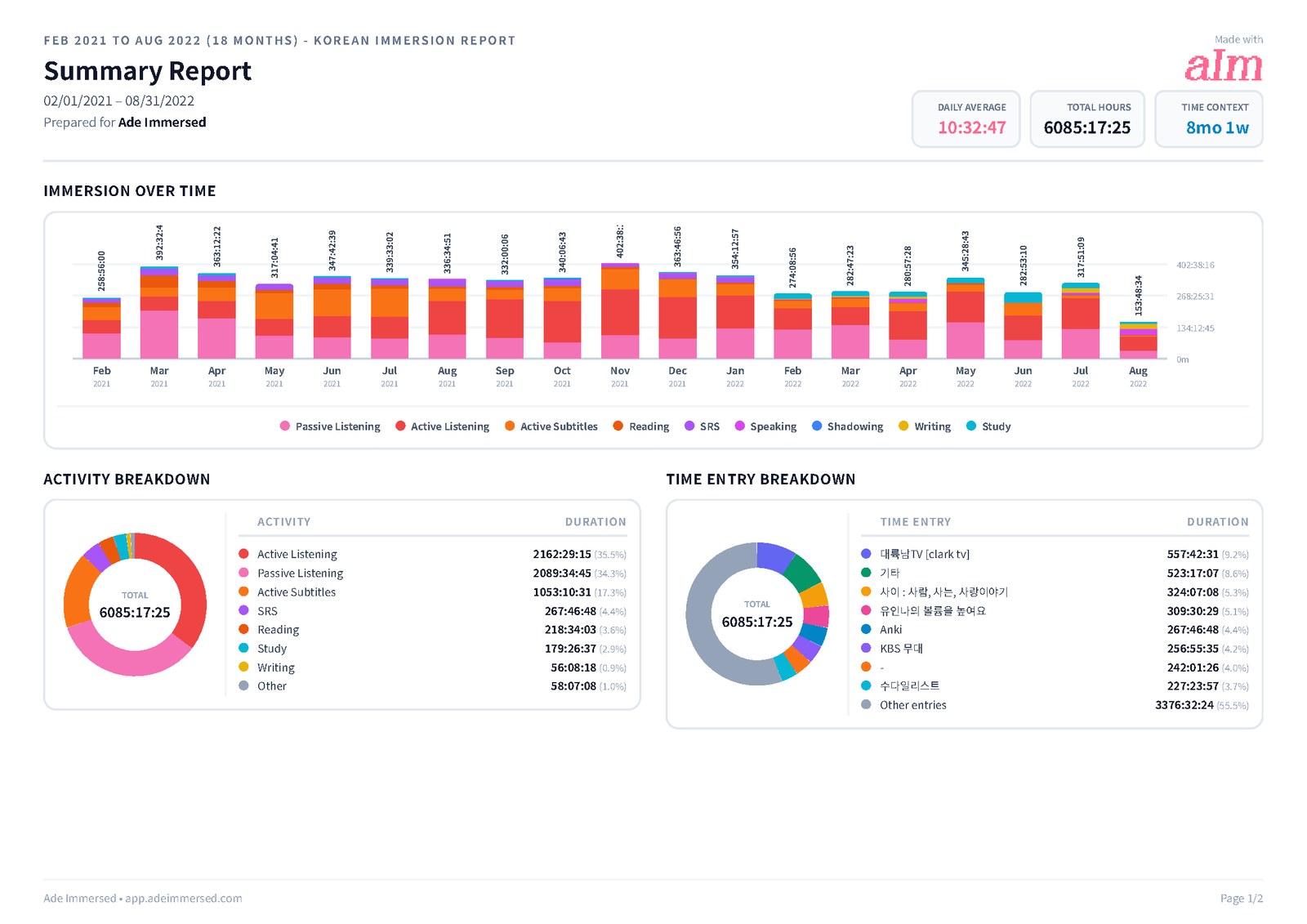
I started Korean in January 2020 the way most people do: Pimsleur, tutors, language exchanges, apps. That summer I went all in on immersion. I watched a 16-episode drama with no subtitles at all, because there were no Korean ones and I refused English, and I wrote a YouTube plan in Korean around the channels I loved: 대륙남 TV, 총몇명, 콕 TV and 잠뜰 TV. My phone, my games and my browser went Korean too.
My domain was web dramas: the short, cheesy campus romances, on repeat as I fell asleep and woke up. When I was tired it was comedy and streams. Later came the sitcom High Kick, the learner reading series 외국인을 위한 한국어 읽기, one a day, and my first novel. Sentence cards came from what I watched, and from the new year of 2021 every card was in Korean.
In February 2021 a Korean YouTuber asked me how many hours I had done, and I had to guess: around 3,000. From that day I tracked every hour in Toggl, by activity and by the exact show or channel. My categories became the nine activities. I logged 3,790 hours in 2021 alone, then studied at Yonsei, the only foreigner in my politics classes. That's more than most people can do, and you don't need my pace. You do need the same honesty about what your hours were made of. Read my story.
Korean's specific hurdles
Korean is hard for English speakers for reasons that have little to do with the alphabet. Knowing which hurdle you're on tells you what kind of content to pick.
- Hangul is the easy part. It's an alphabet, and most people can sound it out within days. I could read it in about forty minutes. Reading is not understanding, though: that only comes with vocabulary, which comes from input
- Speech levels and honorifics. Korean has seven verb paradigms, or speech levels, each with its own endings. Learner content mostly uses polite 해요 style. Dramas switch between polite speech, 반말 among friends and formal endings at work, which is exactly why they teach it so well. Notice who talks to whom, and how
- Word order and particles. The verb comes last and particles like 은/는 and 이/가 do the work English does with word order. Grammar guides help you notice them; hours of input make them automatic
- Sound changes. Final consonants (받침) change how the next syllable sounds, so what you hear isn't always what's written. Korean subtitles at stage 3 are the fix: you see the spelling while you hear the sound. Shadowing helps later
- Two number systems. Sino-Korean numbers for dates, money and minutes; native Korean numbers for hours, ages and counting things, with counters on top. It takes most learners a long time to hear them without thinking
- Few cognates. Apart from English loanwords, little vocabulary will feel familiar. Expect the first few thousand words to take real hours, and let SRS carry some of the load
The tools that help
This is the Korean kit Immersed hand-picks for the free blueprint. Each one does one job; none of them replaces the hours.
- Migaku (or Language Reactor): click words in Netflix and YouTube subtitles and save them with audio and the sentence. I worked with Migaku on its Korean materials. See Immersed vs Migaku
- Kimchi Reader: a popup dictionary made just for Korean, on YouTube, Netflix, Viki and webpages, with hanja and how common each word is. A favourite with Korean learners right now (paid, 7-day free trial)
- Anki: free spaced-repetition flashcards. Ten to twenty minutes a day, made from what you watch rather than random lists. See Immersed vs Anki
- [Naver Dictionary](https://korean.dict.naver.com/koendict/): the go-to Korean dictionary, with real example sentences. Read the examples, not just the English gloss
- KRDict: the National Institute of Korean Language's learner dictionary, with simple Korean definitions for when you're ready to go monolingual. I used it, set to Korean only, to rewrite the backs of my cards
- Papago and DeepL: check a sentence you half understood, then read the Korean again. Don't use them to write what you want to say
- [How to Study Korean](https://www.howtostudykorean.com) and Talk To Me In Korean: look up a grammar pattern after you've met it a few times in content
- For output: italki for conversation once you understand a lot, HelloTalk for exchanges about what you watch, LangCorrect for free corrections on short writing
- [The listening games](/games/listening): free, no account. Korean has eight, more than any other language: Numbers (both Sino-Korean and native), Time, Years, Colors, Animals, Fruits, Zodiac (띠) and Counters, with all-time leaderboards
How to track your Korean
Record every session as it happens: which of the nine activities, the actual show or channel and episode, the minutes, and how much you understood. Once a week, look at the days you showed up, whether your comprehension on the same kind of content is rising, and the mix, before you look at the total. The full method is in how to track your language immersion.
Immersed is a language immersion tracker and planner. It turns immersion into something you can see, plan and keep: a free plan built from your answers, a daily timeline for the shows, podcasts and books you learn from, and reports of your hours. The blueprint is free, with no account (it asks for your name and email): your plan, Hidden time in your day, the five-tool Korean Toolkit above, Library picks to watch, hear and read, and the Foundations of the Fluency Checklist, as a PDF too.
Immersed Pro ($9.99 a month, or $60 a year with a 7-day free week) is the daily part: the timeline, sessions with the nine activities and a comprehension rating, the full Korean Library (with my own picks and the story behind them), Discover's feed of Korean creators and podcasts, Growth reports stacked by activity with your top shows linked, monthly Sprints and streaks. Immersed never reads your viewing history: every session starts with a press. Build your free blueprint.
FAQ
Questions people ask.
How long does it take to learn Korean through immersion?+
Longer than most languages. The State Department's Foreign Service Institute puts Korean in Category IV, its hardest group for English speakers, at 88 weeks and 2,200 class hours for its students. Immersion learners usually need a few thousand hours before native TV feels easy: at two hours a day, roughly four years for 3,000 hours. Passive listening adds hours, and content at the right level makes each hour count for more.
Can you learn Korean just by watching K-dramas?+
Not from zero, and not with English subtitles. A beginner understands too little of a K-drama for it to teach much. Start with learner videos made for comprehension, move to web dramas and easier K-dramas with Korean subtitles at a few hundred hours, and add podcasts and webtoons. Dramas become a main source once you follow the story without translation.
Should I watch K-dramas with English or Korean subtitles?+
Korean, as soon as you can follow the story with them. English subtitles turn the drama into English reading practice. Korean subtitles let you see the spelling while you hear the sound, which fixes Korean's sound changes. If you can't follow with Korean subtitles yet, pick easier content rather than switching to English.
Do I need to learn Hangul before immersing?+
Yes, and it's quick. Hangul is an alphabet, and most learners can sound it out within a few days. Learn it in your first week, alongside learner videos, so you can use Korean subtitles, dictionaries and webtoons from early on. Don't lean on romanization: it gets in the way of reading and of hearing Korean's sounds.
What are the best YouTube channels for Korean comprehensible input?+
For beginners: Comprehensible Korean, KIWI (Korean Input with Images) and 몰입한국어 Immersion in Korean, all in Korean with pictures and gestures. After a few hundred hours, web drama channels like 짧은대본 ShortPaper and PLAYLIST Originals, then native channels on things you like, from cooking (백종원) to documentaries (EBS 다큐).
When should I start speaking Korean?+
When you understand a lot of what you hear, usually somewhere past the first thousand hours. Before that, short shadowing sessions and a little writing are enough. I pushed output to the front about a year in, with language exchanges and shadowing, and by the time I flew to Korea I handled my lost luggage in Korean on my first night.
Is Korean harder than Japanese for English speakers?+
FSI puts both in Category IV at 88 weeks of training. Korean's alphabet is far easier than Japanese kanji, but the grammar is just as far from English and there are fewer familiar words. In practice they take a similar number of hours. See how to learn Japanese through immersion.