Babbel teaches you how the language works. Immersed helps you spend hours in it.
Babbel is a paid course with short, structured lessons that explain grammar and build toward real conversations. Immersed is a language immersion tracker and planner: a free plan built from your answers, then a daily timeline for the shows, podcasts and books you learn from, with reports of your hours. One teaches, the other plans and tracks the listening and reading that make it stick.
Free. About two minutes. No account, no card.
The short version
Checked October 24, 2026.
Something out of date? Tell me.
If you want a clear, adult course that tells you why a sentence works, with speaking practice and the option of live classes, Babbel is a solid choice. Immersed teaches no grammar or vocabulary.
If you have done a course and still can't follow a show or a podcast, what you are missing is hours of real input. Immersed plans those hours around your day, tracks them by activity and shows how your comprehension changes.
Hours alone are one number. What you did in those hours (which of nine activities, at what level, with how much understood) is what turns a course into an ability, and that is what Immersed shows you.
01Two different jobs
A course gives you the map. Immersion is the walking.
Babbel's lessons take as little as ten minutes and are built around dialogues you might really have: ordering, introducing yourself, talking about work. Grammar is explained as you go, and a review system brings words back before you forget them.
That is the part of learning a course does well. What it can't give you is the hundreds of hours of hearing the language at natural speed, in accents and topics the course never covers. Reviewers often point out that Babbel's content thins out past the intermediate level. That is the point where immersion takes over.

02Before you press play
A plan for the hours outside the app.
When you close Babbel, nothing tells you which podcast to try, what to watch tonight, or where twenty minutes of listening could fit in your day.
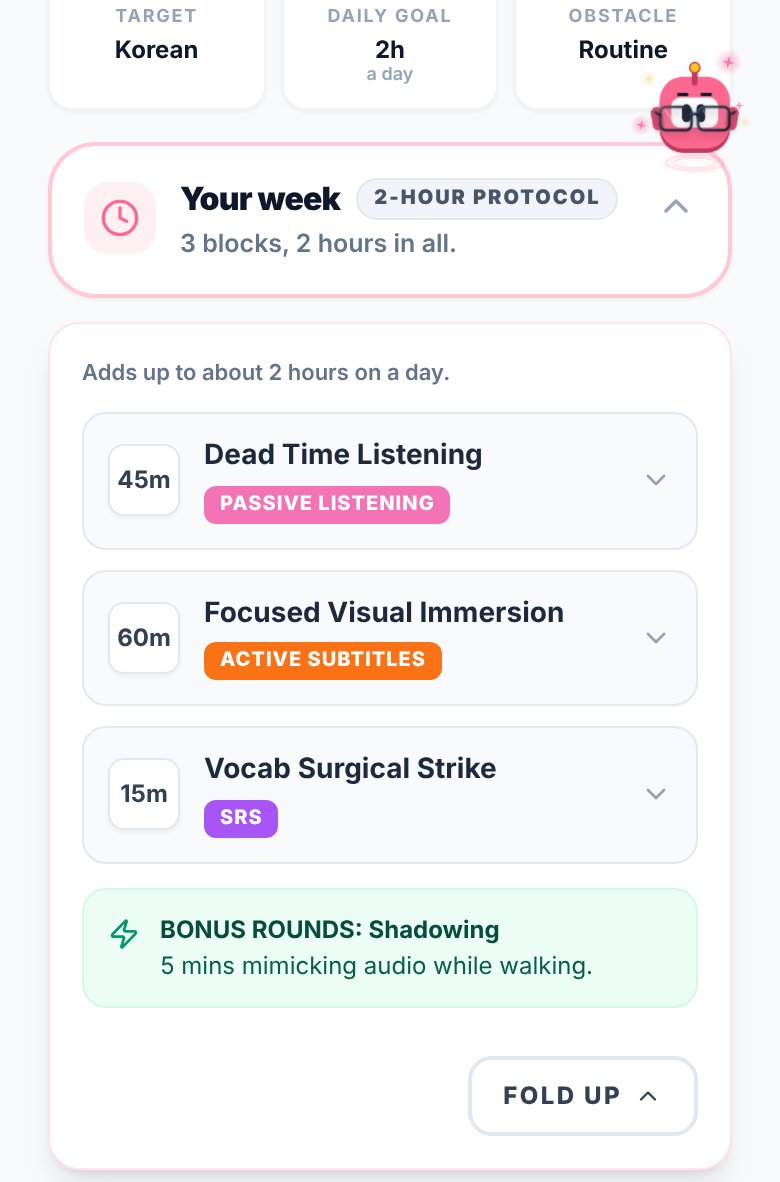
Immersed's free blueprint asks about two minutes of questions about your time, goals, level and what you already watch. It returns milestones for your first months, a daily protocol, the Hidden Immersion Time in your day, a five-tool Immersion Toolkit, an Immersion Library of picks to watch, listen to and read, and the Foundations stage of the Fluency Checklist. No account needed, just a name and email.
03While you immerse
Nine kinds of immersion, one timeline.
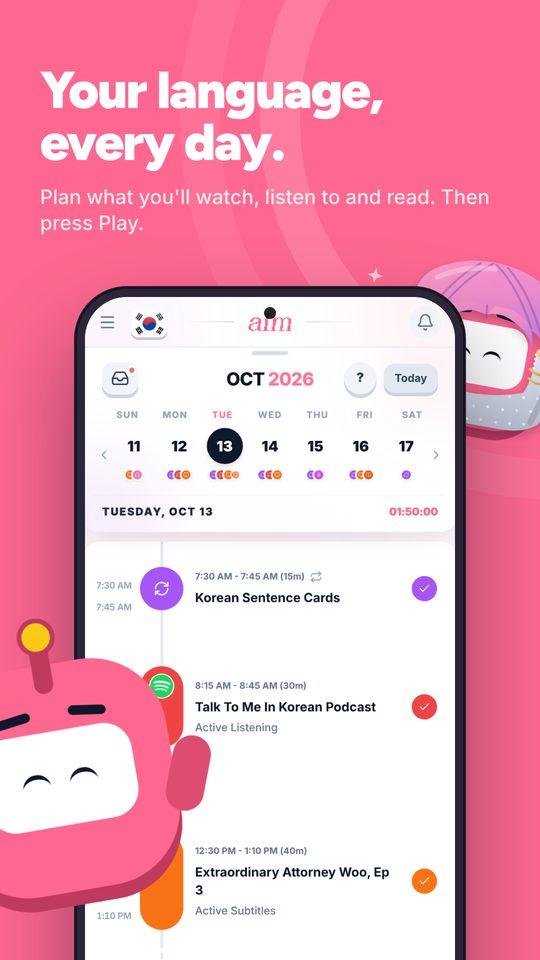
With Immersed Pro you plan your day from Wake up to Wind down and press play when you start. Pick an activity (Active Listening, Passive Listening, Active Subtitles, Reading, Study, SRS, Speaking, Writing or Shadowing), rate how much you understood and add notes.
Your Babbel lessons can go in as Study and a Babbel Live class as Speaking, so the course and the immersion sit in one history. Paste a YouTube, Spotify or Apple Podcasts link and it plays inside the session.
04Looking back
Not just how many hours. What they were made of.
Babbel tracks the lessons you finish and the words due for review. A count of hours would be the next step, but it is still one number: your 1,000 hours and someone else's 1,000 are not the same if one was background audio and the other was focused listening at the right level.
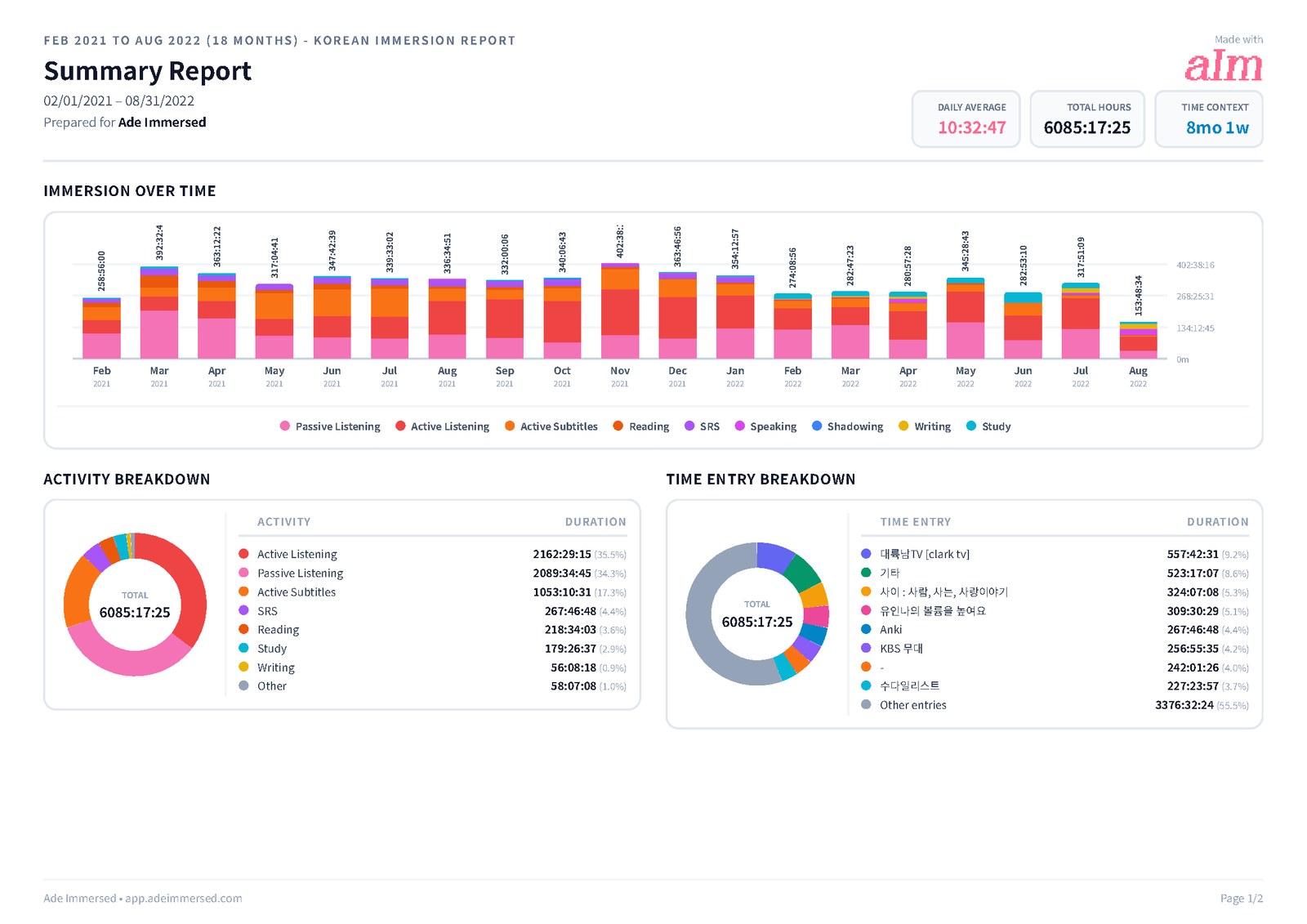
Immersed's Growth page stacks your time by the nine activities, draws your comprehension line over time and keeps a consistency grid with streaks. Reports list your top shows and channels, with links back to them. When the comprehension line climbs on the same kind of podcast, you can see which hours are working. Export a PDF, Excel or CSV, or share a report link.
Side by side · checked October 24, 2026
Immersed and Babbel, feature by feature.
What it is for
Teaches grammar and vocabulary
Immersed · No
Babbel · Yes, with grammar explained in lessons
Absolute beginners
Immersed · Free listening games in 12 languages, with leaderboards; otherwise better after a course
Babbel · Yes
Plan for real immersion in your day
Immersed · Free blueprint and daily timeline
Babbel · No
Immersion milestones for your first months
Immersed · Yes, on the free blueprint
Babbel · No
What to watch, listen to and read next
Immersed · Immersion Library, Toolkit and Discover feed
Babbel · Course content only
Speaking
Speech recognition in lessons
Immersed · No
Babbel · Yes
AI conversation practice
Immersed · No
Babbel · Babbel Speak (beta) and guided conversations
Live classes with a teacher
Immersed · No
Babbel · Babbel Live, small groups, separate plan
Tracking
Hours by activity
Immersed · Nine immersion activities, stacked in reports
Babbel · No
Comprehension rating
Immersed · Per session, charted over time
Babbel · No
Spaced review of words
Immersed · No, logs your SRS time
Babbel · Yes, built in
Top shows and channels in reports
Immersed · Yes, with links back to them
Babbel · No
Export your history
Immersed · PDF, Excel, CSV and share links
Babbel · No
What to do after the course
Immersed · Fluency Checklist stages and monthly Sprints
Babbel · Higher course levels, while they last
Apps and price
Languages
Immersed · Any; Library in 22, hand-picked Toolkit in 11
Babbel · 14 languages
Phone and computer
Immersed · Web app on both; Android app in testing for Google Play
Babbel · iOS, Android and web, with offline lessons
Free plan
Immersed · Blueprint, games with leaderboards, Discord, sample app
Babbel · No full free plan
Paid plan
Immersed · $60 a year or $9.99 a month
Babbel · About $18 a month or $108 a year; lifetime about $300
Credit where it's due
Both are good. At different things.
What Babbel does well
- Clear grammar explanations for adults who want to know why, not just what
- Lessons built around real dialogues, from about ten minutes each
- Speech recognition and AI conversation practice with Babbel Speak
- Babbel Live: unlimited small-group classes with real teachers, about 55 minutes each
- A review system that brings back the words you are about to forget
- Offline lessons, and one subscription that can cover all 14 languages
- A lifetime plan, rare among course apps
What Immersed does that Babbel doesn't
- Plans hours of real immersion around your day, starting with a free blueprint
- Tells you what to watch, listen to and read in your language, with a feed that counts as immersion
- Breaks your hours down by nine activities, from Passive Listening to Shadowing, and charts how much you understood
- Shows your hours, consistency and top shows and channels in reports you can export and share
- Gives you the Fluency Checklist, 32 things an immerser has in place, as the what-now list after the course
- Works for any language you want to track, not only the ones a course offers
Pick Babbel if
- You are a beginner who wants a structured course that explains the grammar
- You want to speak early, with speech recognition, AI practice or live classes
- You are learning one of the big European languages and want a clear path to a solid A2 or B1
- You prefer to pay once and keep it, with the lifetime plan
Pick Immersed if
- You have finished or outgrown a course and want to keep progressing through real content
- You want a plan for listening and reading that fits your actual day
- You want help finding shows, podcasts and books at your level
- You want to see what your hours were made of, and your comprehension rising
- You want a clear list of what to set up next once the course runs out
Use both, or move over
Use Babbel to learn, use Immersed to immerse
A simple pattern: one Babbel lesson a day as Study, plus a podcast on the commute and an episode at night, all logged in Immersed. The lesson gives you the structures; the immersion lets you hear them a thousand times.
Start adding easy input early, once you know a few hundred words and simple sentences, not after you finish the course. As you reach the intermediate lessons, let the immersion hours grow and the course shrink. When Babbel's content runs out, the plan and the habit are already in place, and the Fluency Checklist's stages show what comes next: Foundations is free on the blueprint, the other three stages come with Pro.
Pricing · checked October 24, 2026
What each one costs.
Immersed
- Free: the blueprint for one language (with the Toolkit, Library picks and the Fluency Checklist's Foundations), the listening games in 12 languages with their leaderboards, Aim Runner, the Discord and the sample app. A free account also gets the Fitting Room's day-one outfits for Aim, Hour Marks and badges from game time.
- Immersed Pro: $60 a year (starts with a free week, about $5 a month) or $9.99 a month. Timeline, sessions with the nine activities, Discover, Library, Growth and reports, monthly Sprints, more languages.
Babbel
- Subscription: the US App Store lists one month at $17.99, three months at $45.99 and an all-languages year at $107.99.
- Lifetime: about $300 at list price for all languages, often discounted.
- Babbel Live: unlimited live group classes (up to six learners) on a separate plan that includes the app. Reported prices vary a lot by commitment length, so see their pricing page.
Babbel runs frequent sales, and web prices can differ from the app stores. Babbel is a course you pay for to learn; Immersed is about $5 a month on the yearly plan to plan and track your immersion, and the blueprint is free.
FAQ
Questions people ask.
Is Babbel enough to become fluent?+
It gets many learners to a solid beginner or low intermediate level. Understanding fast native speech usually takes hundreds of hours of listening and reading on top. Immersed is built to plan and track those hours.
Does Immersed teach a language like Babbel?+
No. Immersed doesn't teach grammar or vocabulary. It plans, tracks and shows your immersion. Use a course like Babbel for the structures and Immersed for the hours.
When should I start immersion if I use Babbel?+
Early. Once you can follow simple dialogues, add easy input like learner podcasts and kids' shows. The free blueprint picks things for your level, and the free listening games are an easy first step.
Can I log Babbel lessons and Babbel Live classes in Immersed?+
Yes. Log lessons as Study and live classes as Speaking, live with the timer or afterward. They appear in your Growth reports next to your immersion.
What is Babbel Live?+
Babbel's live online classes with a teacher, in small groups of up to six, on a separate plan that also includes the app. Check Babbel's site for current prices and languages.
Is Immersed cheaper than Babbel?+
Immersed's yearly plan is $60 (about $5 a month) and the blueprint is free. Babbel's yearly plan lists at about $108 in the US App Store. They do different things, so most people who use both are paying for a course and a tracker.
More comparisons
Stop guessing. See what your hours add up to.
Answer a few questions and Immersed builds your plan: a daily routine that fits your life, milestones for your first months, and things to watch at your level. Free, about two minutes, no account needed.
The plan is free and stays free. No card.
Checked October 24, 2026 against published product information. Prices and features change; if something here is out of date, tell me on Discord and I'll fix it.