German rewards the hours you put in. Spend them on the right things at the right level.
German is close enough to English that you'll recognise a lot early, and different enough (genders, cases, verbs at the end) that guessing stops working by month two. Immersion handles that better than drills do, if you choose content you can follow and change it as you grow. This guide gives you the stages, the actual channels, podcasts and sites, and a way to see whether it's working. It's written by the team behind Immersed, a language immersion tracker and planner.
The answer
Learning German through immersion means spending most of your hours watching, listening to and reading German you can mostly follow, starting with learner content like Nicos Weg and Easy German, and moving to native shows, podcasts and news as your comprehension grows. A little grammar and daily flashcards help, but they support the input rather than replace it.
For an English speaker, the US Foreign Service Institute puts German in Category II: about 36 weeks, or 828 class hours, to reach professional working proficiency. Add the self-study FSI students do and it's roughly 1,400 hours. At two hours a day, plan on about two years to understand most native German comfortably.
How long German takes, and what that number means
The US State Department's Foreign Service Institute groups languages by how long its English-speaking students take to reach a score of 3 in speaking and listening (professional working proficiency). German sits in Category II, about 36 weeks or 828 class hours. Dutch, Spanish and Italian are quicker; Vietnamese, Arabic and Japanese take longer.
Those are full-time diplomats with teachers, in class 23 hours a week plus 17 hours of self-study. Count both and German comes to roughly 1,440 hours. Your hours won't map one to one: an hour of a show you follow closely is worth more than an hour of a podcast you half hear. Treat the number as a sense of scale, not a deadline.
What it tells you is that German is a two-year project at two hours a day, and closer to four at one hour a day. That's useful. It means a slow third month isn't failure, it's the middle.
The stages, from zero to understanding
Immersion works in stages because the right content changes as you do. The hour ranges below are rough and assume steady daily time. Move on when the content in your stage feels comfortable, not when the clock says so.
The table uses the nine activities Immersed tracks: Active Listening, Passive Listening, Active Subtitles, Reading, Study, SRS, Speaking, Writing and Shadowing. The mix is the point. Two people with 300 hours can be at very different levels depending on what those hours were made of.
| Stage | Rough hours | Lead with | Also do | Hold off on |
|---|---|---|---|---|
| 1. First sounds and words | 0 to 50 | Active Listening to learner videos; Study (a short course or Nicos Weg); SRS for the top 1,000 words | Shadowing short phrases for a few minutes | Native shows without help; Writing beyond a few lines |
| 2. Learner content | 50 to 300 | Active Listening and Active Subtitles (German subtitles) on learner channels | Passive Listening on the commute; SRS daily; light Reading | Long grammar sessions; Speaking for its own sake |
| 3. Native content with German subtitles | 300 to 900 | Active Subtitles on native shows and YouTube; Reading articles and webtoons | Passive Listening to podcasts you've heard once; first Speaking with a tutor; Writing short posts | English subtitles |
| 4. Native content without subtitles | 900 to 1,500+ | Active Listening to podcasts and shows; Reading longer pieces | Speaking weekly; Writing with corrections; Shadowing to polish word stress | Study, except when one pattern keeps tripping you up |
What to watch, listen to and read at each level
These picks come from the creators, shows and podcasts collected for Immersed's German Library and Discover, checked on 24 October 2026. Pick one or two per column that you'd watch anyway. Interest beats the perfect level.
- Rewatch on purpose. Watch an episode of Nicos Weg or Easy German once actively, then play the audio passively while you cook. You'll catch what you missed
- Kids' TV is real German. Die Maus explains how things work in clear, slow sentences. It's not beneath you at 100 hours
- Use German subtitles, not English. English subtitles turn German into background noise. German ones tie the sound to the spelling
| Level | Watch | Listen | Read |
|---|---|---|---|
| Beginner | Nicos Weg (DW's story series for learners); Easy German street interviews; Peppa Pig Deutsch; Die Maus | Slow German with Annik Rubens; DW's Langsam gesprochene Nachrichten (slow news); German Stories; DeutschFluss | DW's Top-Thema (a short news story with a word list); webtoons in German on WEBTOON |
| Intermediate | Dinge Erklärt (Kurzgesagt's German channel); Galileo; Y-Kollektiv reportages; Dark or How to Sell Drugs Online (Fast) on Netflix with German subtitles | The Easy German Podcast; Deutsch mit Rieke (B2 to C2); Betreutes Fühlen; Quarks Daily; Gemischtes Hack for how friends really talk | NEON at stern.de; stories on Wattpad; DW news in German |
| Advanced | MrWissen2go (politics and history, fast); Simplicissimus essays; ZDF heute-show; Tatort in the ARD Mediathek | 15 Minuten (the tagesschau morning podcast); Lage der Nation; Eine Stunde History; Verbrechen or Mordlust for true crime | Der Spiegel; DWDS example sentences when a word won't stick |
German's hurdles, and how immersion gets you past them
Most of what makes German feel hard is a pattern your ear can learn before your head can explain it. Immersion is how natives learned it. A quick look at the rule helps, then many hours of hearing it.
- Three genders, four cases. Learn every noun with its article (der Tisch, die Lampe, das Buch) and put the article on your SRS card. After a few hundred hours, "den" will start sounding right or wrong before you can say why
- The verb at the end. In "weil ich gestern keine Zeit hatte" the verb waits until the last word. Listen to the end of the sentence before you decide what it means. Shadowing helps your ear expect it
- Separable verbs. "Ich rufe dich morgen an" splits anrufen in two. Easy German's unscripted speech is full of them, which is exactly why it's good practice
- Long compound words. Break them from the right: Handschuh is a hand-shoe, a glove. Reading makes this automatic faster than listening does
- Numbers backwards. 21 is einundzwanzig, one-and-twenty. The free Numbers listening game drills this until it stops slowing you down
- Austria, Switzerland and Bavaria. Start with standard German from Germany (DW, ZDF, ARD). Add Austrian and Swiss speakers once you follow the standard. Swiss German dialect is a project of its own
Tools that help
You need a dictionary, a flashcard app and something to help with subtitles. The rest is optional. Most of these are the ones Immersed hand-picks for German on its free blueprint.
- Dictionaries: DWDS for real usage examples, LEO or dict.cc for fast German-English lookups and noun genders
- Translator: DeepL to check a sentence you half understood. Then read the German again
- Grammar reference: DW Learn German for cases and word order, Grimm Grammar (University of Texas) for deeper explanations
- Flashcards: Anki, every day, with words from what you watched, not random lists
- While you watch: Migaku or Language Reactor for clickable subtitles on Netflix and YouTube. I used to work at Migaku, and Migaku links in Immersed are affiliate links
- Speaking and writing, from stage 3: italki for tutors, HelloTalk for exchanges, LangCorrect for free corrections from native speakers
A week of German at stage 2, ninety minutes a day
Here's what the learner-content stage can look like on a normal working week. Swap the content for things you like; keep the shape.
- Morning commute, 30 minutes: Passive Listening to an Easy German Podcast episode you've already heard once
- Lunch, 15 minutes: SRS, reviewing words you met yesterday
- Evening, 40 minutes: Active Subtitles on an Easy German video or an episode of Nicos Weg, German subtitles on
- Before bed, 5 minutes: Shadowing three lines from that episode
- Weekend: one long Active Listening session, and a short Study session on whatever pattern kept coming up
How to track your German immersion
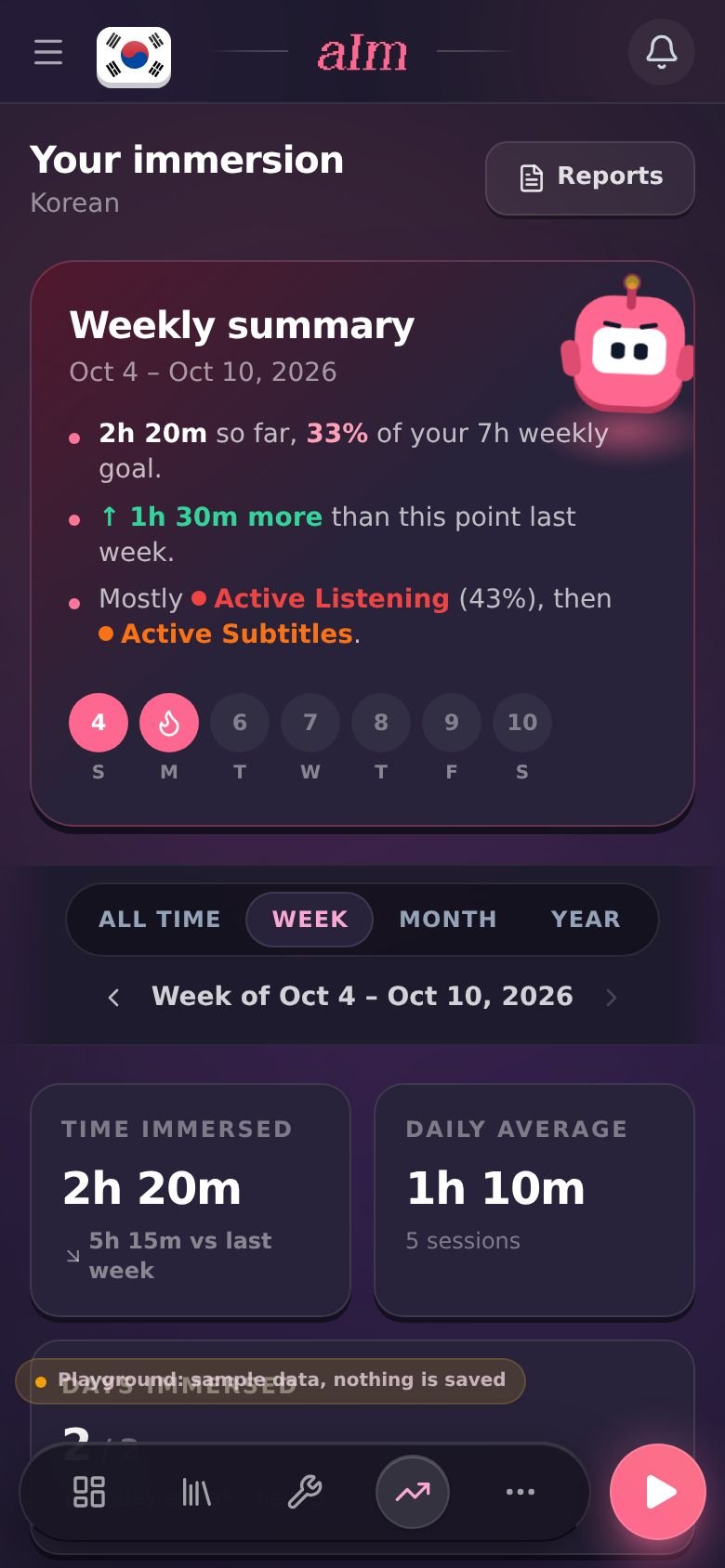
Write down each session as it happens: which of the nine activities, the actual content ("Nicos Weg, episode 4", not "YouTube"), the minutes, and how much you understood. Once a week, look at the days you showed up, then whether comprehension on similar content is rising, then the mix, and only then the total.
For German, the mix tells you the most. If week after week is SRS and Study with little Active Listening, you're studying German rather than acquiring it. If it's all Passive Listening, plan one show you follow closely. See how to track your immersion for the full method.
Where Immersed fits
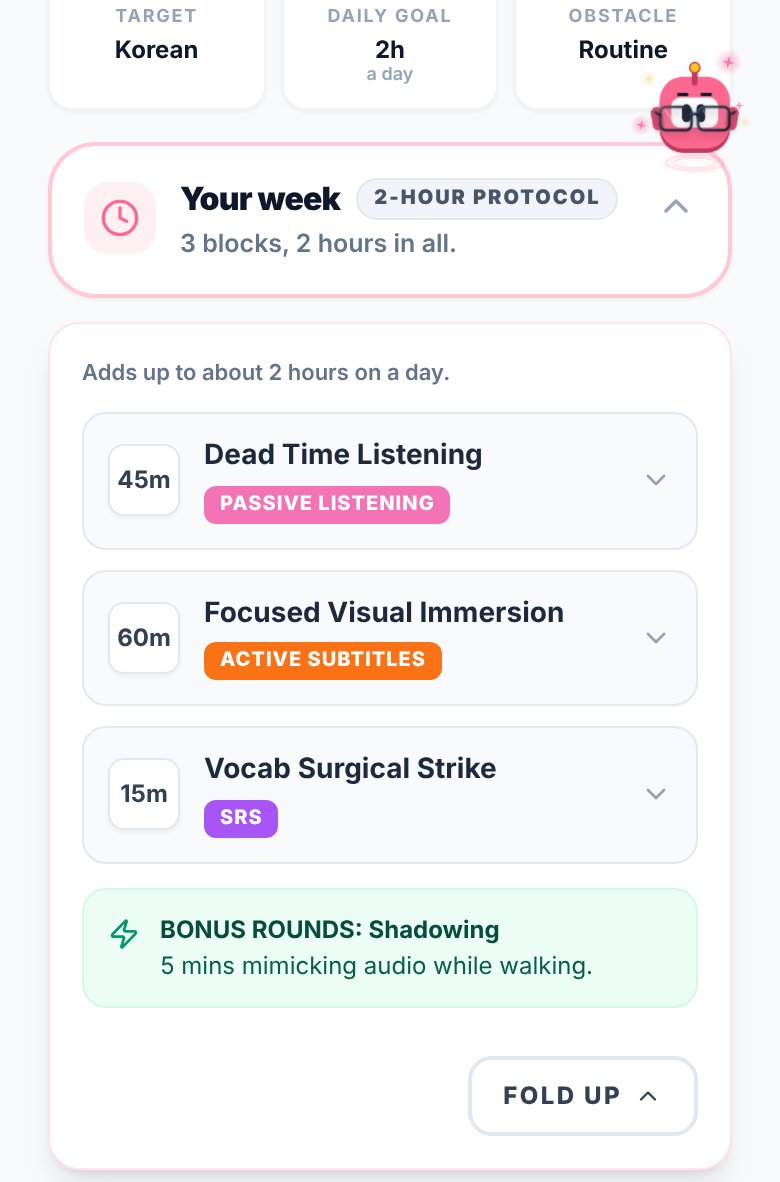
Immersed is a language immersion tracker and planner. It turns immersion into something you can see, plan and keep: a free plan built from your answers, a daily timeline for the shows, podcasts and books you learn from, and reports of your hours.
The blueprint is free with no account (it asks for your name and email). For German you get a plan for your day, the Hidden time where German fits, the hand-picked five-tool Toolkit above, a few platforms with up to ten real picks to watch, listen to and read, and the Foundations stage of the Fluency Checklist. The listening games (Numbers, Time, Years, Colors, Animals, Fruits) are free in German with all-time leaderboards.
Immersed Pro ($9.99 a month, or $60 a year with a 7-day free week) adds the timeline, sessions across the nine activities with comprehension ratings, reports that break your hours down by activity, the full German Library, and Discover, a feed of German creators and podcasts where scrolling logs itself. Immersed never reads your viewing history; a session starts when you press play. Build your free German blueprint.
FAQ
Questions people ask.
How long does it take to learn German through immersion?+
The Foreign Service Institute puts German in Category II, about 36 weeks or 828 class hours for its students to reach professional working proficiency; with their self-study, roughly 1,440 hours. At two hours a day that's about two years to understand most native German comfortably. Your pace depends on how much of that time is content you can actually follow.
Can you learn German just by watching TV?+
You can get a long way, if it's TV you can follow. Start with learner shows like Nicos Weg and Easy German, use German subtitles rather than English, and add a little grammar and daily flashcards. Native shows like Dark work better from a few hundred hours in. Speaking needs practice of its own later, but understanding comes from input.
What should a beginner watch to learn German?+
Nicos Weg from Deutsche Welle is built for beginners and free. Easy German's street interviews have German and English subtitles. Peppa Pig Deutsch and Die Maus are slow, clear and real. For listening, try Slow German with Annik Rubens and DW's slowly spoken news.
Should I learn German grammar before immersion?+
Learn just enough to recognise what you hear: articles and genders, the four cases in outline, and that verbs go to the end of some clauses. An hour or two with DW Learn German covers it. Then go back to content and look a rule up only when it keeps blocking you.
Is German hard for English speakers?+
It's in the middle. FSI puts it a step above Spanish, Italian and French and well below Arabic or Japanese. Lots of words look familiar; cases, genders and word order take time. Immersion helps because those are patterns your ear learns from many examples.
Should I learn Austrian or Swiss German?+
Start with standard German as spoken in Germany, since most learner content and media use it, and Austrians and Swiss people understand it. Add Austrian and Swiss speakers once standard German is comfortable. Swiss German dialect is close to a separate language, so treat it as a later project if you need it.