Arabic is two languages in one. Choose which you need first, then immerse in that one.
Arabic is one of the longest projects an English speaker can take on, and the first decision matters more than in most languages: Modern Standard Arabic (MSA), the shared formal language of news and books, or a spoken dialect such as Egyptian or Levantine, the Arabic of daily life, dramas and YouTube. This guide covers that choice, the first weeks with the script, the stages, the actual channels, podcasts and sites for each variety, and a way to see your progress. It's written by the team behind Immersed, a language immersion tracker and planner.
The answer
Learning Arabic through immersion means choosing a target first, a spoken dialect, MSA, or both in a set order, and then spending most of your hours watching, listening to and reading Arabic in that variety that you can mostly follow: learner podcasts and kids' cartoons first, then vlogs, talk shows and podcasts, then news and long interviews. The alphabet, daily flashcards and a little grammar support the input.
For an English speaker, the US Foreign Service Institute puts Arabic in Category IV, its "super-hard languages": 88 weeks, or 2,200 class hours, to reach professional working proficiency. With the self-study FSI students do, that's roughly 3,500 hours, which is about three years at three hours a day or close to five at two.
How long Arabic takes, and what that number means
The US State Department's Foreign Service Institute sorts languages by how long its English-speaking students take to reach a score of 3 in speaking and listening (professional working proficiency). Arabic is in Category IV with Mandarin, Cantonese, Japanese and Korean: 88 weeks, or 2,200 class hours. That's about four times Italian.
FSI students are full-time: 23 hours a week in class and 17 of self-study, so roughly 3,500 hours in all. Your hours won't count the same, since an hour you follow closely builds far more than an hour in the background. But the scale is real. Arabic is a multi-year project, and a plan that fits your actual day matters more than a burst of motivation.
The good news: you don't need all of it to enjoy it. Understanding one dialect well enough for vlogs and conversation comes much sooner than full command of MSA and a dialect together.
MSA or a dialect: what to learn first
Arabic lives in two layers. MSA (فصحى, fusha) is used in writing, news, formal speeches and many dubbed cartoons, and it's the same across the Arab world. Dialects (عامية) are what people speak at home, with friends and in most dramas, vlogs and podcasts. Natives grow up with both; nearby dialects understand each other well, distant ones much less. Egyptian is one of the most widely understood, thanks to decades of Egyptian film and TV.
Choose by what you want to do. To talk with people, follow dramas or YouTube, start with the dialect of the people or country you care about. To read news and books or study religious and classical texts, start with MSA. Most learners end up with both: a dialect for listening and speaking, MSA for reading. Pick one to lead with for your first few hundred hours, and add the other once the first feels familiar.
| Variety | Where you hear it | Picks to start with |
|---|---|---|
| MSA (Standard) | News, documentaries, books, many dubbed cartoons | KONDOSAN Arabic fairy tales; AJ+ عربي; Qasid Arabic Podcast; DW Documentary in Arabic |
| Egyptian | Films, TV, comedy, much of Arab pop culture | Salis (Learn Egyptian Arabic); Learn Egyptian Arabic with Eslam Badawy; El Daheeh الدحيح |
| Levantine (Syria, Lebanon, Jordan, Palestine) | Dramas, YouTube, many learner podcasts | Learn Levantine Arabic with Alaa; Learn Levantine Arabic with Livi; karameesh; Our Family Life حياة عيلتنا |
| Gulf | Saudi, Kuwaiti and Emirati media and podcasts | مغامرات منصور (Mansour's Adventures); إذاعة ثمانية and its podcast فنجان |
| Maghrebi (Moroccan Darija and neighbours) | Morocco, Algeria, Tunisia | The Daily Darija Podcast |
The first weeks: the script
Learn the alphabet in your first week or two, before anything else. Arabic has 28 letters, written right to left, and most letters change shape depending on where they sit in a word. It looks like a wall at first and takes most learners days, not months.
Two things make reading harder than the alphabet suggests. Short vowels are usually not written, so you read كتب and have to know whether it's kataba (he wrote) or kutub (books). And words are built from three-letter roots: k-t-b gives kitab (book), maktab (office, desk), kaatib (writer). Learn to spot roots early; it turns new words into old ones.
- Start with vowelled text. Children's stories and learner materials print the short vowels (harakat). Use them until you recognise common words without
- Read what you hear. Arabic subtitles on kids' cartoons tie the sound to the spelling
- Use your ears on the hard sounds. ع, ح, ق, خ and غ have no English match. Shadowing a few minutes a day trains them faster than reading about them
The stages, from zero to understanding
The right content changes as you do, so immersion works in stages. The hours are rough and for your lead variety. Move on when your current content feels comfortable.
The table uses the nine activities Immersed tracks: Active Listening, Passive Listening, Active Subtitles, Reading, Study, SRS, Speaking, Writing and Shadowing. In Arabic the mix carries extra weight: Reading and Study pull toward MSA, Listening and Speaking toward dialect, so your mix shows which Arabic you're actually building.
| Stage | Rough hours | Lead with | Also do | Hold off on |
|---|---|---|---|---|
| 1. Script, sounds, first words | 0 to 100 | Study of the alphabet; Active Listening to beginner podcasts in your variety; SRS with audio | Shadowing the hard sounds; Reading vowelled text | Native TV; a second variety |
| 2. Learner content and cartoons | 100 to 600 | Active Listening and Active Subtitles (Arabic subtitles) on learner channels and kids' shows | Passive Listening to episodes you've heard once; SRS daily; short Reading | English subtitles |
| 3. Native content with Arabic subtitles | 600 to 2,000 | Active Subtitles on vlogs, comedy and dramas; Active Listening to podcasts; Reading short news | First Speaking with a tutor in your dialect; Writing short messages; the second variety | Long grammar sessions |
| 4. Native content without subtitles | 2,000 to 3,500+ | Active Listening to long interviews and podcasts; Reading articles and books | Speaking weekly; Writing with corrections; Shadowing for rhythm | Study, except for one pattern that keeps tripping you up |
What to watch, listen to and read at each level
These picks come from the creators, shows and podcasts collected for Immersed's Arabic Library and Discover, with their dialect, checked on 24 October 2026. Choose from your lead variety first.
- Cartoons are an MSA classroom. Many children's shows are dubbed into clear, slow MSA. They're the gentlest native MSA listening there is
- Dialect lives on YouTube and in podcasts. For Egyptian, Levantine or Gulf, native vlogs and talk shows are where you hear it as people speak it
- Rewatch on purpose. Watch once actively, then play the audio passively the same day
| Level | Watch | Listen | Read |
|---|---|---|---|
| Beginner | KONDOSAN Arabic fairy tales (MSA); karameesh (Jordanian kids' TV); مغامرات منصور (Gulf); dubbed cartoons on Nickelodeon Arabia (MSA) | Learn Levantine Arabic On The Go (Khaled Nassra); Learn Levantine Arabic with Alaa; Salis (Egyptian); The Daily Darija Podcast (Moroccan) | Vowelled children's stories; Arabic subtitles on the cartoons you watch |
| Intermediate | Our Family Life حياة عيلتنا (Levantine family comedy); Ibn Hattuta Travels (Levantine travel vlogs); AJ+ عربي (short MSA reports); Roya Comedy (Jordanian sketches) | Learn Levantine Arabic with Livi; Real Syrian Arabic; Qasid Arabic Podcast (MSA); ما وراء اللغة; El Daheeh (Egyptian) | AJ+ captions; short news on Al Jazeera; webtoons in Arabic on WEBTOON |
| Advanced | DW Documentary in Arabic (MSA); ثمانية documentaries; Arabic dramas on Shahid | فنجان with Abdulrahman Abumalih (long Saudi-hosted interviews); Hikmat Wehbi Podcast (Lebanese); Al Jazeera Arabic | Al Jazeera; Mada Masr; novels and long reads |
Tools that help
Immersed doesn't hand-pick an Arabic Toolkit yet. The free blueprint gives Arabic learners Language Reactor and Anki, with the dictionary, translator and grammar cards found for Arabic when the blueprint is built. These are tools that work well for Arabic either way.
- While you watch: Language Reactor for dual subtitles and click-to-look-up on Netflix and YouTube
- Flashcards: Anki daily, with audio, and the root noted on each card
- Dialect dictionaries: the Living Arabic Project has large Egyptian and Levantine dictionaries plus Gulf, Iraqi, North African and Classical ones
- MSA dictionary: Hans Wehr, the classic root-ordered dictionary of written Arabic, once you can find a word's root
- Translator: Google Translate for gist checks, mostly reliable for MSA, much less for dialect
- Speaking and writing, from stage 3: italki for tutors (choose one who speaks your dialect), HelloTalk for exchanges, LangCorrect for free corrections
- Numbers by ear: the free Arabic listening games drill numbers, time, years, colours, animals and fruit, with romanization. The number words are MSA counting forms
How to track your Arabic immersion
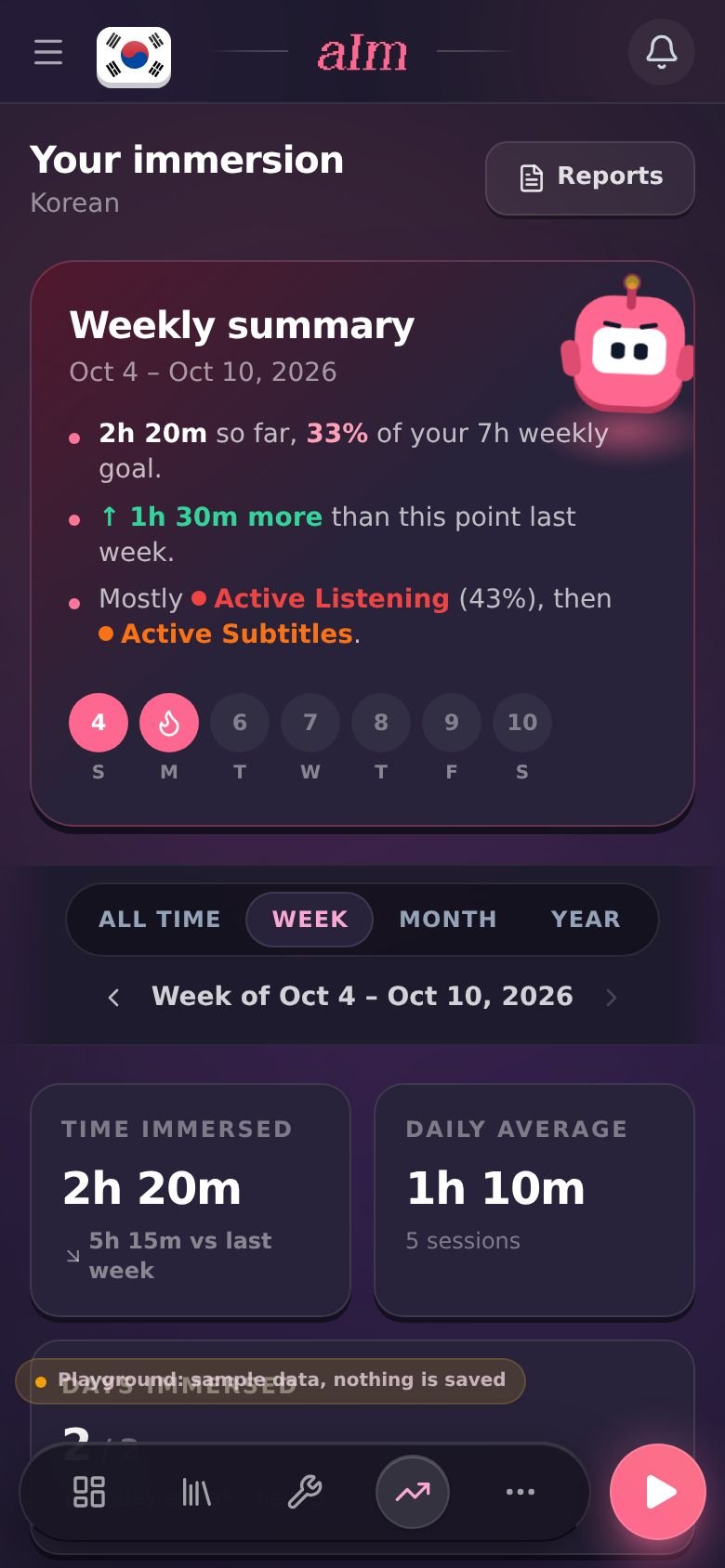
Record each session as it happens: which of the nine activities, the actual content (the channel and episode, not just "YouTube"), the minutes, how much you understood, and which variety it was in. Once a week, look at the days you showed up, then whether comprehension is rising, then the mix, then the total.
Tag sessions by variety (MSA, Egyptian, Levantine...) so you can see whether your hours match the Arabic you said you wanted. A month of news and textbooks with a goal of chatting in Levantine is a sign to change the mix. See how to track your immersion for the full method.
Where Immersed fits
Immersed is a language immersion tracker and planner. It turns immersion into something you can see, plan and keep: a free plan built from your answers, a daily timeline for the shows, podcasts and books you learn from, and reports of your hours.
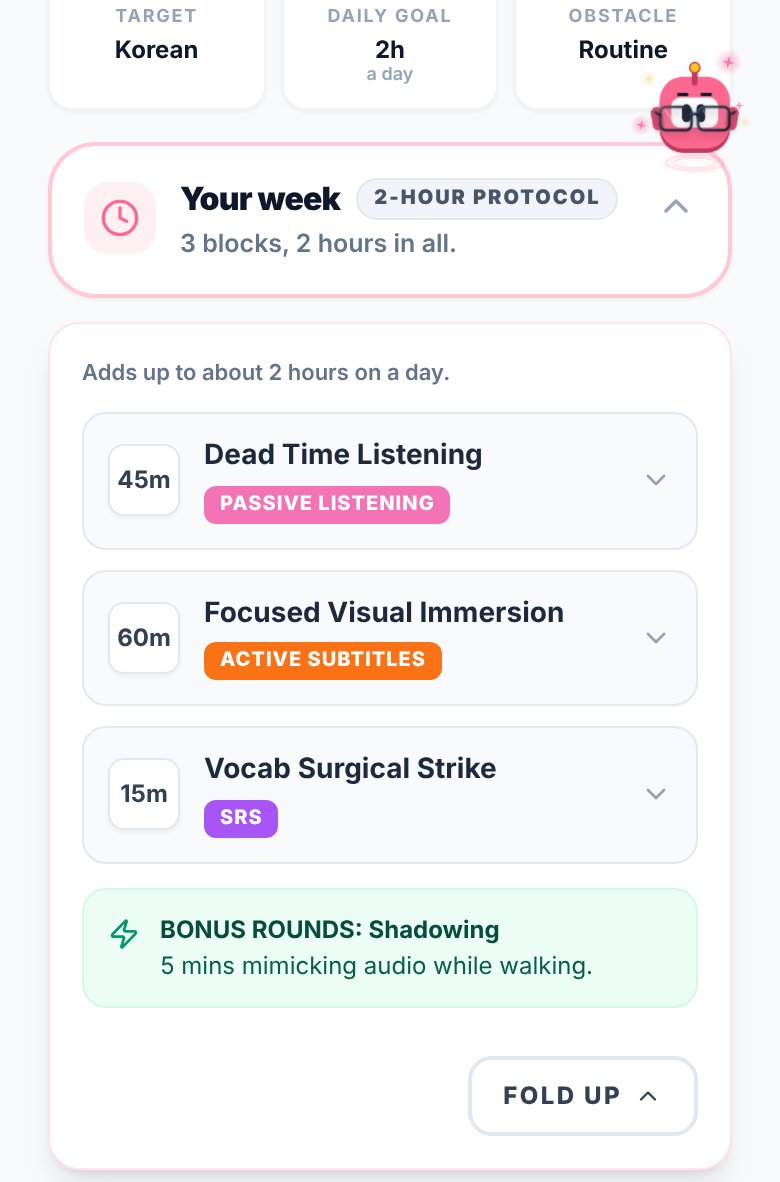
The blueprint is free with no account (it asks for your name and email). For Arabic it gives you a plan for your day, the Hidden time where Arabic fits, the five-tool Toolkit (Language Reactor, Anki and tools found for Arabic, not a hand-picked kit), a few platforms with up to ten real picks, and the Foundations stage of the Fluency Checklist. The listening games are free in Arabic with all-time leaderboards.
Immersed Pro ($9.99 a month, or $60 a year with a 7-day free week) adds the timeline, sessions across the nine activities with comprehension ratings, reports by activity, and Discover, which covers Arabic: a feed of Arabic creators and podcasts where scrolling logs itself. The Pro Library has a Dialect filter (Egyptian, Levantine, Gulf, MSA, Classical, Maghrebi, Iraqi, Sudanese, Yemeni) and labels religious content, so you see picks in the Arabic you chose. Immersed never reads your viewing history; a session starts when you press play. Build your free Arabic blueprint.
FAQ
Questions people ask.
Should I learn MSA or a dialect first?+
Learn a dialect first if you want to talk with people, follow dramas or watch YouTube; learn MSA first if you want to read news and books or study classical texts. Most learners end up with both. Lead with one for your first few hundred hours, then add the other.
How long does it take to learn Arabic through immersion?+
The Foreign Service Institute puts Arabic in Category IV: 88 weeks, or 2,200 class hours, for its students to reach professional working proficiency, and roughly 3,500 hours with their self-study. That's about three years at three hours a day. Understanding one dialect for everyday content comes sooner.
Which Arabic dialect should I learn?+
The one spoken by the people or country you care about. With no preference, Egyptian is one of the most widely understood thanks to Egyptian film and TV, and Levantine has a lot of learner podcasts and dramas. Gulf and Maghrebi make sense if you're headed there.
Can I learn Arabic by watching TV?+
Yes, once you can read the script and follow simple speech. Start with kids' cartoons (often in MSA) and learner podcasts in your dialect, use Arabic subtitles, and move to vlogs, comedy and dramas as you understand more. Add daily flashcards and, later, a tutor who speaks your dialect.
How long does it take to learn the Arabic alphabet?+
Most learners can recognise all 28 letters in a week or two of short daily practice. Reading fluently takes longer, because short vowels usually aren't written. Start with vowelled children's stories and learner texts.
Is Arabic the hardest language for English speakers?+
It's in FSI's hardest group, with Mandarin, Cantonese, Japanese and Korean. The script is quicker to learn than it looks; what takes the time is the sounds, the root-based vocabulary, and having MSA and a dialect to learn.