LingoDeer teaches you how the sentence works. Immersed plans the hours where you hear it.
LingoDeer is a course app with a grammar-first path, native-speaker audio and careful script lessons, and it is a favourite of beginners in Japanese, Korean and Chinese. Immersed is a language immersion tracker and planner. It turns immersion into something you can see, plan and keep: a free plan built from your answers, a daily timeline for the shows, podcasts and books you learn from, and reports of your hours.
Free. About two minutes. No account, no card.
The short version
Checked October 24, 2026.
Something out of date? Tell me.
If you are starting Japanese, Korean or Chinese and want the script, the sounds and the basic grammar explained clearly, LingoDeer is one of the best apps for it. Immersed teaches no grammar or vocabulary.
If you have finished the beginner levels and still can't follow a drama, a variety show or a podcast, the gap is hours of real listening. Immersed plans those hours around your day, tracks them and shows you the proof.
Use LingoDeer to learn the structure and Immersed to immerse, starting before you finish. Levels and hours are each one number; what you did in those hours is what builds the ability, and that is what Immersed shows you.
01What each one is for
A grammar path for the start, and a plan for the hours after it.
LingoDeer's lessons are written by language teachers and follow a clear path, with grammar notes inside each lesson, studio audio from native speakers, character drills for Japanese and Chinese, flashcards, mini stories and a travel phrasebook. Reviewers who compare it with Duolingo usually say the same thing: fewer languages, but more depth for Japanese, Korean and Mandarin.
Its limit is the one every course has. Exercises lean on multiple choice, and one learner who finished the Japanese course on the WaniKani forums called it beginner to low intermediate at most. Understanding a native speaker at full speed takes hundreds of hours of hearing them, and that happens outside the course.
- LingoDeer measures lessons, levels and review
- Immersed measures hours of real listening, reading and watching, split across nine activities, with how much you understood
02Before you press play
From textbook sentences to a real drama.
The jump from course audio to a Korean drama or a Japanese YouTuber is big, and nothing in a course tells you which show is at your level or where an hour of listening fits in your day.
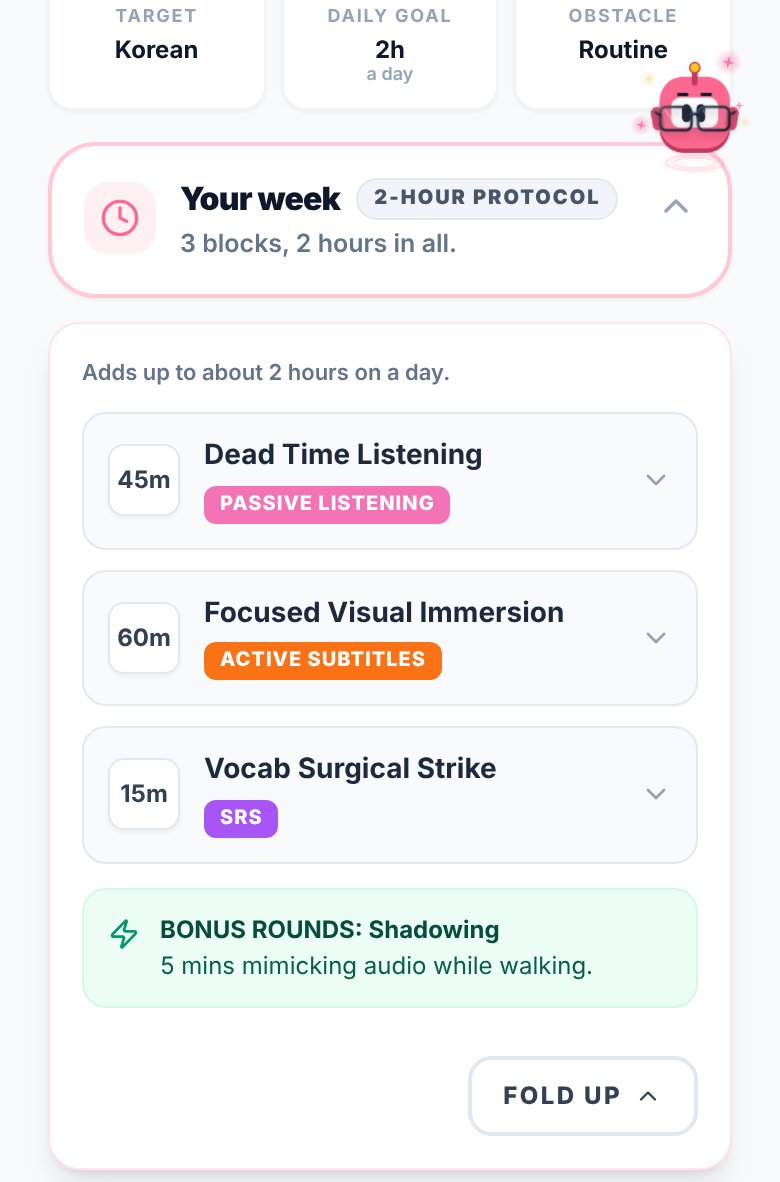
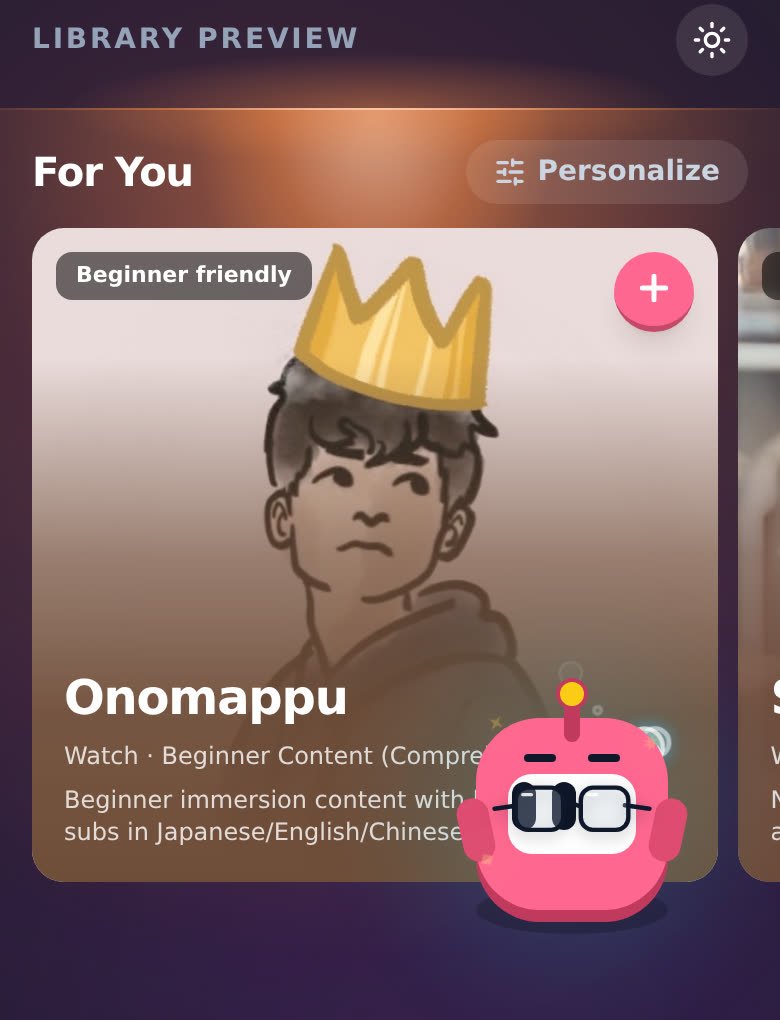
Immersed starts with a free blueprint: about two minutes of questions about your time, goals, level and what you already watch. It returns milestones for your first months, a daily protocol, the Hidden Immersion Time in your day, a five-tool Immersion Toolkit and an Immersion Library with picks from the main platforms for Watch, Listen and Read. Japanese, Korean, Mandarin and Cantonese all get a hand-picked Toolkit and the full Library, and in the Library (Pro) Korean has my own picks, with my story behind each. No account needed, just a name and email.
03While you immerse
A timeline for your day, and a timer for real input.
With Immersed Pro, the timeline runs from Wake up to Wind down. Plan an episode into the lunch gap and a podcast into the commute, set repeating tasks, get reminders and tick them off.
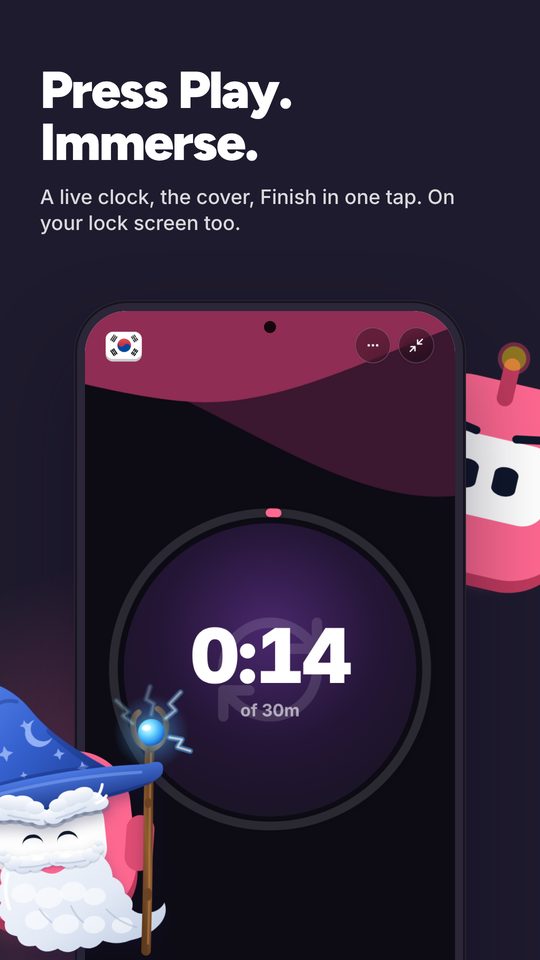
Press play and pick one of nine activities, from Active Subtitles and Passive Listening to Reading and Shadowing. Paste a YouTube, Spotify or Apple Podcasts link and it plays inside the session. Your LingoDeer lessons can go in as Study, so the course and the immersion sit in one history.
04Looking back
Levels finished, hours heard, and what the hours were made of.
LingoDeer shows you which lessons and levels you have done. That is the right measure while you are in the course. After it, a count of hours is not enough on its own: your 1,000 hours and someone else's 1,000 are not the same if one was dramas in the background and the other was shows at your level with full attention.
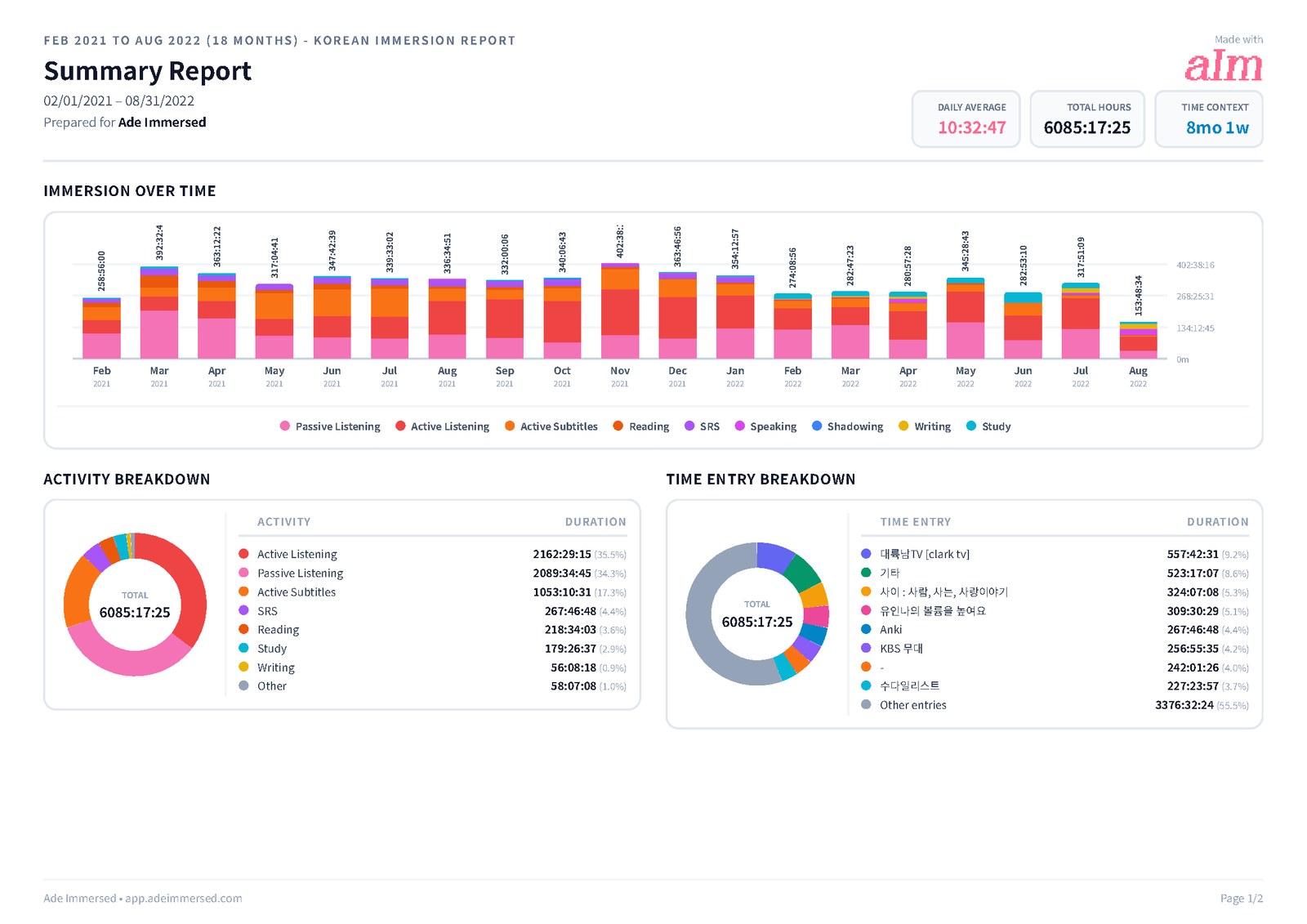
Immersed's Growth page stacks your time by the nine activities, draws your comprehension line over time and keeps a consistency grid with streaks. Reports list your top shows and channels, with links back to them. When you understand more of the same kind of show month after month, you see it, and you see which hours did it. Export a PDF, Excel or CSV, or share a report link.
Side by side · checked October 24, 2026
Immersed and LingoDeer, feature by feature.
What it is for
Teaches grammar and vocabulary
Immersed · No
LingoDeer · Yes, grammar-first lessons with notes
Scripts (kana, kanji, hangul, hanzi)
Immersed · No
LingoDeer · Yes, with character drills for Japanese and Chinese
Absolute beginners
Immersed · Free listening games in 12 languages, with leaderboards; otherwise better after a course
LingoDeer · Yes, built for day one
Plan for real immersion in your day
Immersed · Free blueprint and daily timeline
LingoDeer · No
Immersion milestones for your first months
Immersed · Yes, on the free blueprint
LingoDeer · No
What to watch, listen to and read next
Immersed · Immersion Library, Toolkit and Discover feed
LingoDeer · Mini stories inside the app
Practice
Native-speaker audio
Immersed · Plays real YouTube, Spotify and podcast audio in a session
LingoDeer · Studio-recorded lesson audio
Speaking
Immersed · Logs Speaking and Shadowing time
LingoDeer · Conversation practice for Japanese, Korean, Chinese, Spanish and French
Offline
Immersed · Logs offline and syncs later; no downloads
LingoDeer · Yes
Tracking
Hours by activity
Immersed · Nine immersion activities, stacked in reports
LingoDeer · No
Comprehension rating
Immersed · Per session, charted over time
LingoDeer · No
Top shows and channels in reports
Immersed · Yes, with links back to them
LingoDeer · No
Automatic tracking
Immersed · One press to start; Discover scroll and games log themselves; never reads history
LingoDeer · Tracks lessons inside the app
Export your history
Immersed · PDF, Excel, CSV and share links
LingoDeer · No
Rewards for hours of real content
Immersed · Outfits for Aim, badges and monthly Sprints, earned by immersing
LingoDeer · No
Apps and price
Languages
Immersed · Any; Library in 22, hand-picked Toolkit in 11
LingoDeer · 20 courses
Platforms
Immersed · Web app on phone and computer; Android app in testing for Google Play
LingoDeer · iOS, Android and web
Free plan
Immersed · Blueprint, games with leaderboards, Discord, sample app
LingoDeer · Starter content; full access needs a subscription
Paid plan
Immersed · $60 a year or $9.99 a month
LingoDeer · US App Store: from $14.99 a month, $95.99 a year, lifetime from $119.99
Credit where it's due
Both are good. At different things.
What LingoDeer does well
- Grammar explained inside the lessons, not left for you to guess
- Careful script teaching for Japanese, Korean and Chinese, with character drills
- Lessons written by language teachers, with studio audio from native speakers
- Deeper Asian language courses than most big apps, by reviewers' accounts
- Offline lessons, flashcards, mini stories and a travel phrasebook
- Printable grammar Knowledge Cards for review
- A 4.7 rating from about 28,000 reviews on the US App Store
What Immersed does that LingoDeer doesn't
- Plans hours of real immersion around your actual day, starting with a free blueprint
- Tells you what to watch, listen to and read in your language, with a feed that counts as immersion
- Breaks your hours down by nine activities, from Active Subtitles to Shadowing, and charts how much you understood
- Shows your hours, consistency and top shows and channels in reports you can export and share as proof
- Rewards real immersion: Aim's outfits, badges and monthly Sprint medallions come from logged hours, and none are sold
- Gives you the Fluency Checklist and monthly Sprints for after the course
Pick LingoDeer if
- You are starting Japanese, Korean or Chinese and want the script and grammar explained clearly
- You want a structured beginner path instead of piecing it together yourself
- You like knowing why a sentence works before you hear it in the wild
- You want lessons you can do offline on a commute
Pick Immersed if
- You have finished the beginner levels and still can't follow a drama or a podcast
- You know the script and basic grammar and want a plan for hours of listening and reading
- You want help finding shows, channels and books at your level
- You want to see what your hours were made of, and rising comprehension, not levels finished
Use both, or move over
Use LingoDeer to learn, use Immersed to immerse
Keep LingoDeer for the grammar and log it in Immersed as Study. Add easy input alongside it: a learner podcast on the commute, a slow YouTube channel at lunch, a kids' show or a simple drama with subtitles at night.
A good moment to start immersing is once you can read the script and know a few hundred common words and basic sentence patterns. For Japanese or Korean that is often within the first LingoDeer level, not after it. When the course is done, the immersion hours carry on, and the blueprint's first-month sprints and the Fluency Checklist show you what to do next.
Pricing · checked October 24, 2026
What each one costs.
Immersed
- Free: the blueprint for one language (with the Toolkit, Library picks and the Fluency Checklist's Foundations), the listening games in 12 languages with their leaderboards, Aim Runner, the Discord and the sample app. A free account also gets the Fitting Room's day-one outfits for Aim, Hour Marks and badges from game time.
- Immersed Pro: $60 a year (starts with a free week, about $5 a month) or $9.99 a month. Timeline, sessions with the nine activities, Discover, Library, Growth and reports, monthly Sprints, more languages.
LingoDeer
- Free: you can start without paying. Reviews describe the alphabet and pronunciation lessons and the first unit as free; the App Store says full access to all courses needs a subscription.
- Multilingual Pass on the US App Store: $14.99 a month, $34.99 a quarter, $83.99 for six months, $95.99 a year.
- Lifetime on the US App Store: listed at $119.99 and $159.99, plus other lifetime and discount offers.
- LingoDeer Plus, a separate games app, is sold as its own subscription.
LingoDeer runs frequent sales on its website (a 75% off, three-year offer was live when I checked), so the App Store price is rarely the only one. Immersed is about $5 a month on the yearly plan, and the blueprint is free, so you can get your plan before you pay for anything.
FAQ
Questions people ask.
Is LingoDeer better than Duolingo for Japanese and Korean?+
Many reviewers think so. LingoDeer has fewer languages, but it explains grammar and scripts in more depth for Japanese, Korean and Chinese. Either way, a course gets you to the start of real listening, not to the end of it.
How far does LingoDeer take you?+
Beginner to low intermediate. Learners who finish it say it builds a solid base, but most exercises are multiple choice and it does not get you to following native speech. That part takes hours of listening and reading.
How much does LingoDeer cost?+
On the US App Store when I checked on 24 October 2026, the Multilingual Pass was $14.99 a month or $95.99 a year, with lifetime options listed from $119.99. LingoDeer often runs bigger discounts on its own website, so check there too.
Does Immersed teach Japanese or Korean like LingoDeer?+
No. Immersed doesn't teach grammar or vocabulary. It plans, tracks and shows your immersion. Japanese and Korean both get a hand-picked Toolkit and the full Immersion Library.
When should I move from LingoDeer to immersion?+
Earlier than most people think. Once you can read the script and recognise common words and simple patterns, add easy input alongside the lessons. You don't need to finish every level first.
Can I log my LingoDeer time in Immersed?+
Yes, as a Study session, live with the timer or afterward. Immersed doesn't connect to LingoDeer and never reads what you do in other apps, so you log it yourself. For immersion you press play once, and the Discover scroll and the free listening games log themselves.
Does Immersed have anything extra for Korean learners?+
Yes. The free listening games have 8 Korean games, including the zodiac animals (띠) and counters, with all-time leaderboards, free in the browser today. Aim Korean, a standalone Android app with the same games, is coming to Google Play but is not out yet. In the Library (Pro), Korean has my own picks with my story behind each.
More comparisons
Stop guessing. See what your hours add up to.
Answer a few questions and Immersed builds your plan: a daily routine that fits your life, milestones for your first months, and things to watch at your level. Free, about two minutes, no account needed.
The plan is free and stays free. No card.
Checked October 24, 2026 against published product information. Prices and features change; if something here is out of date, tell me on Discord and I'll fix it.