Vietnamese is learned through the ear. Tones make sense after hundreds of hours of hearing them.
Vietnamese uses the Latin alphabet, has no verb conjugation and no genders, and still takes English speakers a long time, because meaning lives in tones and vowels English doesn't have. That makes it a language where listening matters more than almost anything else. This guide gives you the stages, the actual channels, podcasts and sites, how to pick between northern and southern speech, and a way to see your progress. It's written by the team behind Immersed, a language immersion tracker and planner.
The answer
Learning Vietnamese through immersion means spending most of your hours listening to and watching Vietnamese you can mostly follow, in one accent to start: learner podcasts and kids' shows first, then vlogs like Giang Ơi and Khoai Lang Thang, then native podcasts, TV and news. Short daily tone and pronunciation practice, plus flashcards, support the input.
For an English speaker, the US Foreign Service Institute puts Vietnamese in Category III, the "hard languages": about 44 weeks, or 1,012 class hours, to reach professional working proficiency. With the self-study FSI students do, that's roughly 1,760 hours, or about two and a half years at two hours a day.
How long Vietnamese takes, and what that number means
The US State Department's Foreign Service Institute sorts languages by how long its English-speaking students take to reach a score of 3 in speaking and listening (professional working proficiency). Vietnamese is in Category III, with Russian, Thai and Turkish, at about 44 weeks or 1,012 class hours. Only Category IV (Arabic, Mandarin, Cantonese, Japanese, Korean) takes longer.
FSI students are full-time: 23 hours a week in class and 17 of self-study, so roughly 1,760 hours in all. Your hours won't count the same, since an hour you follow closely builds far more than an hour in the background. As a sense of scale: about two and a half years at two hours a day.
Reading is quick to start, since the alphabet is Latin. Understanding speech is the long part. Plan your hours around listening.
Northern or southern: pick one accent first
Vietnamese has three main accent groups: northern (Hanoi), central (Huế and around) and southern (Ho Chi Minh City). Northern speech keeps six distinct tones; southern speech merges the hỏi and ngã tones, so it has five. Several consonants sound different too: in Hanoi d, gi and r all sound like a z, while in the south d, gi and v sound close to an English y.
Northern Vietnamese is the standard on national TV and radio and in many textbooks. Southern Vietnamese is what most of the diaspora speaks, and a lot of entertainment comes out of Ho Chi Minh City. Pick the one where your family, partner, friends or plans are. With no preference, pick the one whose content you enjoy more.
Stay with your choice for the first few hundred hours. Learners who mix accents early often struggle to hear tones at all. Once one accent is comfortable, adding the other mostly means learning a handful of sound changes and words.
| Northern (Hanoi) | Southern (Ho Chi Minh City) | |
|---|---|---|
| Tones | Six: ngang, huyền, sắc, hỏi, ngã, nặng | Five: hỏi and ngã merge |
| d, gi, r | All like z | d and gi like y; r often like r |
| Yes (polite) | vâng | dạ |
| Bowl | bát | chén |
| Sick | ốm | bệnh |
| Thousand | nghìn | ngàn |
| Where to hear it | VTV24, VOV news, Đài Hà Nội | Vietcetera, VITAMESE, HowToVietnamese |
The stages, from zero to understanding
The right content changes as you do, so immersion works in stages. The hours are rough. Move on when your current content feels comfortable.
The table uses the nine activities Immersed tracks: Active Listening, Passive Listening, Active Subtitles, Reading, Study, SRS, Speaking, Writing and Shadowing. In Vietnamese, the mix in the first stage matters more than in most languages: tone and vowel work early saves months later.
| Stage | Rough hours | Lead with | Also do | Hold off on |
|---|---|---|---|---|
| 1. Tones, vowels, first words | 0 to 80 | Active Listening to beginner podcasts in your accent; Shadowing tones and vowels daily; Study of the tone marks | SRS with audio on every card | Native TV; Speaking before you can hear the tones |
| 2. Learner content and kids' shows | 80 to 400 | Active Listening and Active Subtitles (Vietnamese subtitles) on learner channels and kids' shows | Passive Listening to episodes you've heard once; Reading captions and short posts | The other accent |
| 3. Native vlogs and podcasts with subtitles | 400 to 1,100 | Active Subtitles on vlogs and talk shows; Active Listening to podcasts | First Speaking with a tutor; Writing short messages; Reading news | English subtitles |
| 4. Native content without subtitles | 1,100 to 1,800+ | Active Listening to news, podcasts and variety shows; Reading longer pieces | Speaking weekly; Writing with corrections; the other accent, if you want it | Study, except for one pattern that keeps tripping you up |
What to watch, listen to and read at each level
These picks come from the creators, shows and podcasts collected for Immersed's Vietnamese Library and Discover, checked on 24 October 2026. Vietnamese has fewer learner channels than European languages, so kids' shows and vlogs do more of the early work.
- Kids' content earns its place. Clear speech, short sentences and pictures make it the best native input for your first few hundred hours
- Rewatch on purpose. Watch a video once actively, then play the audio passively the same day. Tones you missed the first time stand out the second
| Level | Watch | Listen | Read |
|---|---|---|---|
| Beginner | Learn Vietnamese With Annie; Wolfoo Tiếng Việt; Hello Jadoo Việt Nam (a family cartoon dubbed into Vietnamese); Pinkfong's Vietnamese songs | Vietnamese for Everybody's Podcast; Southern Vietnamese Lessons (HowToVietnamese); Go Vietnamese | Your SRS cards and video captions, until reading tone marks is automatic |
| Intermediate | Giang Ơi (vlogs about becoming an adult); Khoai Lang Thang (food and travel); Vietcetera; Dustin On The Go talk shows | VITAMESE (southern); Learn Authentic Vietnamese; Vietnamese Shadowing; Giang ơi Radio; Tri Kỷ Cảm Xúc; Tóm tắt sách cùng Tanya (book summaries) | Kenh14 (pop culture); Báo Mới; stories on Wattpad |
| Advanced | VTV24 (national TV news); Vie Channel variety shows such as Rap Việt; Ghiền Mì Gõ comedy skits | VnExpress Podcasts (Hôm nay, Hộp đen); VOV news; Đài Hà Nội's late-night story readings; Spiderum | VnExpress for national news |
Vietnamese hurdles, and how immersion gets you past them
Grammar is not the problem in Vietnamese. Sound is. Almost every hurdle is solved by listening a lot, early, with attention.
- Tones. Ma, má, mà, mã, mả, mạ are six different words (ghost, mother, but, horse, grave, rice seedling). Learn to hear them before you worry about saying them: listen, shadow, repeat
- Vowels. Ư, ơ and â have no English match. A few minutes of Shadowing every day for the first months does more than any explanation
- Short, clipped syllables. Final p, t and c are cut off, not released. Your ear adjusts with hours; nothing else fixes it
- Pronouns. "You" and "I" depend on age and relationship: anh, chị, em, bạn, cô, chú. Vlogs and talk shows are the easiest way to hear who calls whom what
- Typing. Install a Vietnamese keyboard (Telex is the common one) so you can look words up with their tone marks
- Fewer learner resources. Compared with Spanish or German, there are fewer graded podcasts. Lean on kids' shows, then vlogs, and rewatch more than you would elsewhere
Tools that help
Immersed hand-picks the dictionary and translator cards for Vietnamese on its free blueprint; the grammar card is filled for your language when the blueprint is built.
- Dictionaries: VDict for Vietnamese-English lookups while you read, Wiktionary for pronunciation and examples
- Translator: Google Translate for quick gist checks
- Flashcards: Anki daily, with native audio on every card so you learn the tone with the word
- While you watch: Migaku or Language Reactor for clickable subtitles on Netflix and YouTube. I used to work at Migaku, and Migaku links in Immersed are affiliate links
- Speaking and writing, from stage 3: italki for tutors (choose one with your accent), HelloTalk for exchanges, LangCorrect for free corrections
- Numbers by ear: the free Vietnamese listening games drill numbers, time, years, colours, animals and fruit. The number words are the northern forms (nghìn, linh); southern speakers say ngàn and lẻ
How to track your Vietnamese immersion
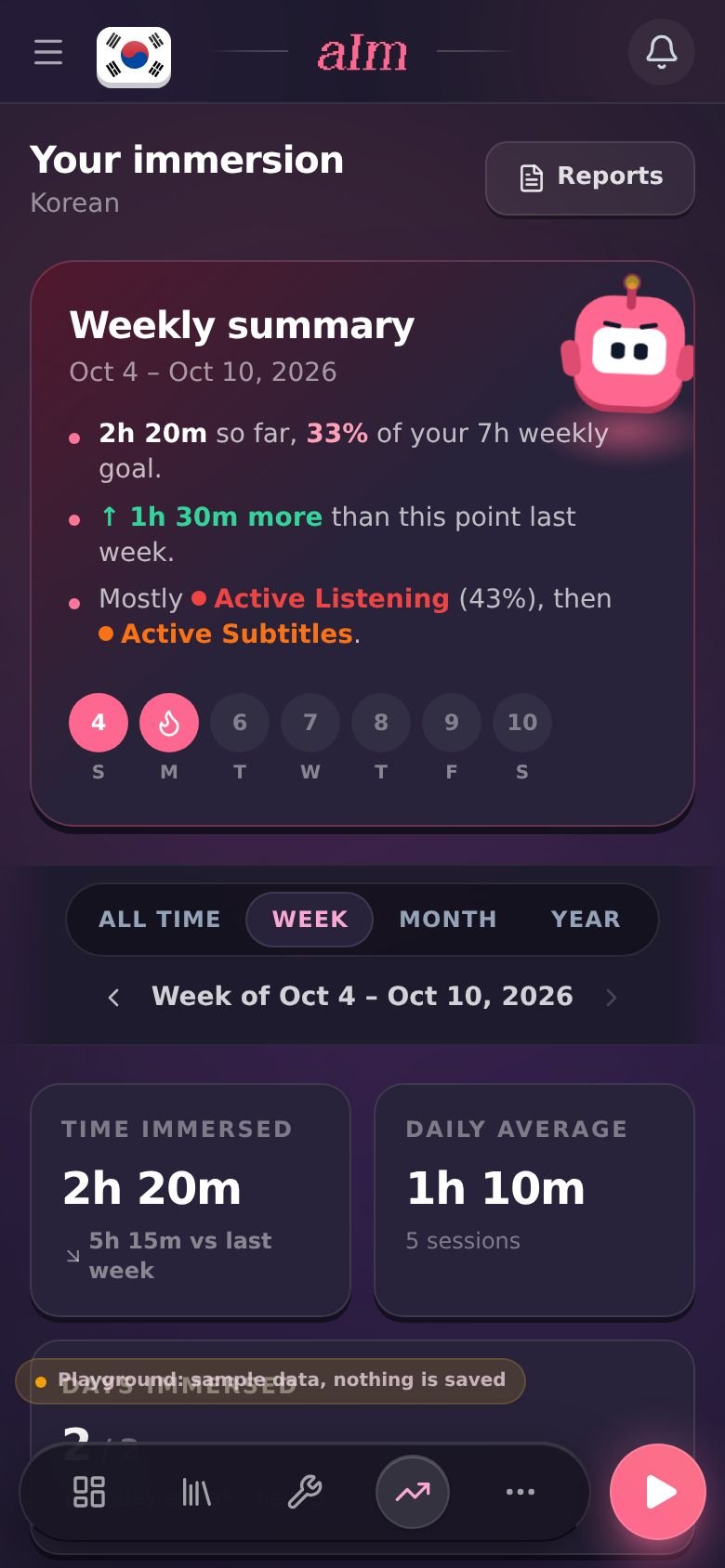
Record each session as it happens: which of the nine activities, the actual content (the channel and the video title, not just "YouTube"), the minutes, and how much you understood. Once a week, look at the days you showed up, then whether comprehension is rising on similar content, then the mix, then the total.
In Vietnamese, watch the share of Shadowing and Active Listening in your first few hundred hours. If it's mostly SRS and Reading, your eyes are ahead of your ears, and the tones will catch up with you later. See how to track your immersion for the full method.
Where Immersed fits
Immersed is a language immersion tracker and planner. It turns immersion into something you can see, plan and keep: a free plan built from your answers, a daily timeline for the shows, podcasts and books you learn from, and reports of your hours.
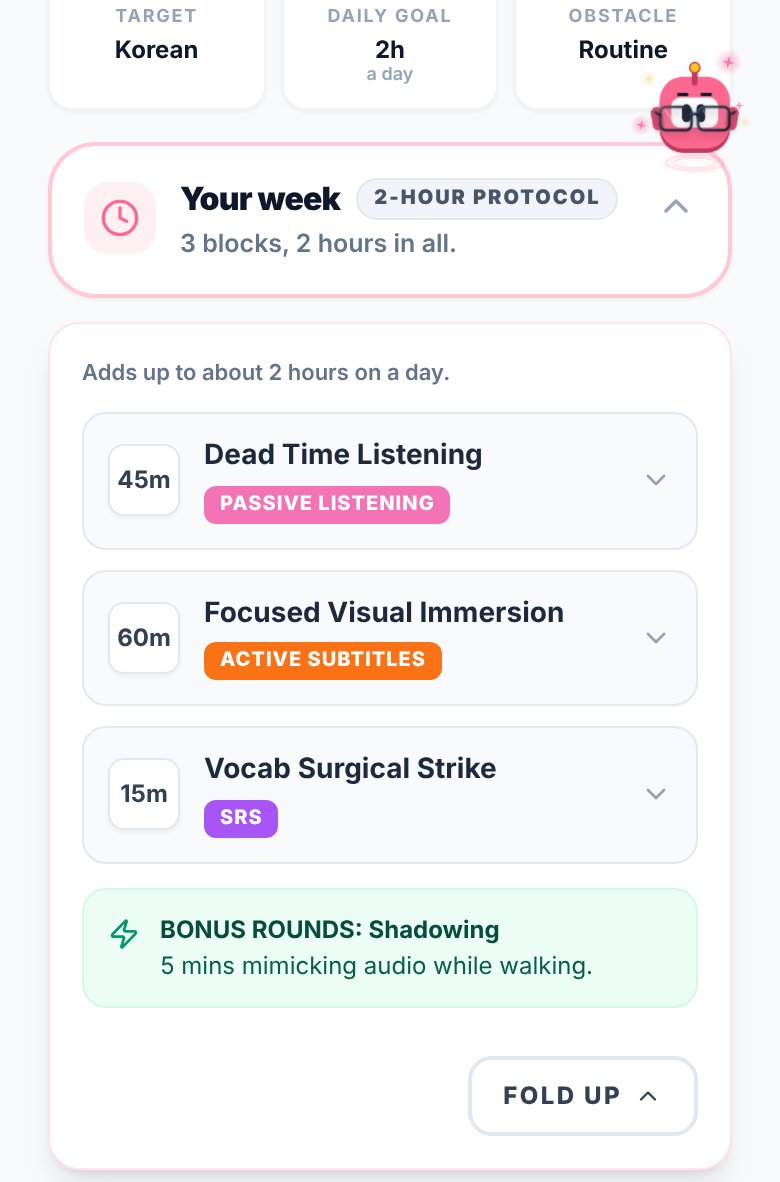
The blueprint is free with no account (it asks for your name and email). For Vietnamese it gives you a plan for your day, the Hidden time where Vietnamese fits, the five-tool Toolkit above, a few platforms with up to ten real picks, and the Foundations stage of the Fluency Checklist. The listening games are free in Vietnamese with all-time leaderboards.
Immersed Pro ($9.99 a month, or $60 a year with a 7-day free week) adds the timeline, sessions across the nine activities with comprehension ratings, reports by activity, the full Vietnamese Library, and Discover, which covers Vietnamese: a feed of Vietnamese creators and podcasts where scrolling logs itself. Immersed never reads your viewing history; a session starts when you press play. Build your free Vietnamese blueprint.
FAQ
Questions people ask.
How long does it take to learn Vietnamese through immersion?+
The Foreign Service Institute puts Vietnamese in Category III: about 44 weeks, or 1,012 class hours, for its students to reach professional working proficiency, and roughly 1,760 hours with their self-study. At two hours a day that's about two and a half years. Listening is the long part.
Should I learn northern or southern Vietnamese?+
Learn the accent of the people you want to talk to. Northern (Hanoi) is the standard on national TV and radio; southern (Ho Chi Minh City) is what most of the diaspora speaks. Stick to one for your first few hundred hours, then add the other.
How do I learn Vietnamese tones?+
By hearing them a lot before you try to produce them. Shadow short phrases daily from a native speaker in your chosen accent, put audio on every flashcard, and listen to learner podcasts and kids' shows. Tones that sound identical at first separate after a few hundred hours.
Can you learn Vietnamese by watching YouTube?+
Yes, if you start with content you can follow: learner channels like Learn Vietnamese With Annie, then kids' shows, then vlogs like Giang Ơi and Khoai Lang Thang with Vietnamese subtitles. Add daily Shadowing and flashcards, and speaking with a tutor once you understand a lot.
Is Vietnamese hard for English speakers?+
Grammar is simple: no conjugation, no genders, no plurals to memorise. The sounds are hard: six tones in the north, vowels English lacks, clipped endings. FSI rates it a hard language, mainly for that reason.
What should I read to learn Vietnamese?+
Start with captions and your flashcards until tone marks feel automatic. Then pop-culture sites like Kenh14 and the Báo Mới news aggregator, and VnExpress once you're comfortable with news vocabulary.