Pick Brazil or Portugal first. Then spend your hours in content from that side of the Atlantic.
Portuguese is one of the quicker languages for English speakers, and there is a lot of it to immerse in, most of it Brazilian. The first real decision is which variety you want to understand and speak, because Brazilian and European Portuguese sound very different. This guide covers that choice, the stages, the actual channels, podcasts and sites for each variety, and a way to see your progress. It's written by the team behind Immersed, a language immersion tracker and planner.
The answer
Learning Portuguese through immersion means spending most of your time watching, listening to and reading Portuguese you can mostly follow, in the variety you chose: for Brazil, channels like Português com Marcia Macedo and Speaking Brazilian, then native YouTube, podcasts and TV; for Portugal, Portuguese With Leo and Practice Portuguese, then Portuguese news and podcasts. Flashcards and a little grammar support the input.
For an English speaker, the US Foreign Service Institute puts Portuguese in Category I, its fastest group: 24 weeks, or 552 class hours, to reach professional working proficiency. With the self-study FSI students do, that's roughly 960 hours, or about a year and a half at two hours a day.
Brazil or Portugal: choose before you start
Both are one language. Written Portuguese barely differs and the two are mutually intelligible. Spoken, they're far apart: European Portuguese reduces or drops many unstressed vowels, so setembro sounds closer to "stembru", while Brazilian Portuguese keeps vowels open and rhythm more even. Many Brazilians find speech from Portugal hard to follow at first.
Choose the one where your people, plans or favourite content are. If you have no preference, Brazilian Portuguese has far more content to immerse in. Then stay with it for your first few hundred hours. Mixing both early makes the sounds harder to pin down; adding the other later is easy.
- Pronouns: most of Brazil uses você for "you"; Portugal uses tu with friends and você more carefully
- Grammar: "estou falando" in Brazil, "estou a falar" in Portugal; object pronouns sit in different places
- Words: ônibus and autocarro (bus), trem and comboio (train), celular and telemóvel (mobile phone)
How long Portuguese takes, and what that number means
The US State Department's Foreign Service Institute sorts languages by how long its English-speaking students take to reach a score of 3 in speaking and listening (professional working proficiency). Portuguese is in Category I, with Spanish, French and Italian, at 24 weeks or 552 class hours.
FSI students are full-time, with 23 hours a week in class and 17 of self-study, so the real total is closer to 960 hours. Your hours won't count the same way: an hour of a show you follow closely builds far more than an hour in the background. Use it as a sense of scale: about 16 months at two hours a day, two and a half years at one hour. If you speak Spanish, expect it to go faster.
The stages, from zero to understanding
The right content changes as you do, so immersion works in stages. The hours are rough. Move on when your current content feels comfortable.
The table uses the nine activities Immersed tracks: Active Listening, Passive Listening, Active Subtitles, Reading, Study, SRS, Speaking, Writing and Shadowing. What your hours are made of matters as much as how many there are.
| Stage | Rough hours | Lead with | Also do | Hold off on |
|---|---|---|---|---|
| 1. First sounds and words | 0 to 40 | Active Listening to beginner podcasts in your variety; Study (a short course); SRS for common words | Shadowing to get nasal vowels and rhythm right early | Native TV without help |
| 2. Learner content | 40 to 200 | Active Listening and Active Subtitles (Portuguese subtitles) on learner channels | Passive Listening to episodes you've heard once; light Reading; SRS daily | The other variety |
| 3. Native content with Portuguese subtitles | 200 to 600 | Active Subtitles on native YouTube and series; Reading news and webtoons | First Speaking with a tutor; Writing short posts; Passive Listening on the commute | English subtitles |
| 4. Native content without subtitles | 600 to 1,000+ | Active Listening to native podcasts, talk shows and TV; Reading longer pieces | Speaking weekly; Writing with corrections; the other variety, if you want it | Study, except for one pattern that keeps tripping you up |
What to watch, listen to and read: Brazilian Portuguese
These picks come from the Brazilian creators, shows and podcasts collected for Immersed's Portuguese Library and Discover, checked on 24 October 2026.
| Level | Watch | Listen | Read |
|---|---|---|---|
| Beginner | Português com Marcia Macedo; Vou Aprender Português; Brasileirices; Turma da Mônica; Peppa Pig em Português Brasil | Speaking Brazilian Podcast; Carioca Connection; Tudo bem? Brazilian Portuguese | Webtoons in Portuguese on WEBTOON; stories on Wattpad |
| Intermediate | Manual do Mundo (experiments and how things work); Nerdologia; Ciência Todo Dia; Brazilian series on Netflix with Portuguese subtitles | Philipe Brazuca Podcast; Naruhodo (science questions); Não Inviabilize (listeners' stories) | g1 and Globo; UOL |
| Advanced | Roda Viva (TV Cultura interviews since 1986); Café Filosófico CPFL; Inteligência Ltda | O Assunto (daily news); Rádio Novelo Apresenta; Que História É Essa, Porchat? | Folha de S.Paulo; Priberam definitions instead of English ones |
What to watch, listen to and read: European Portuguese
There's less European Portuguese content, but enough to get to understanding. These picks are tagged Portugal in the same collection.
- Rewatch on purpose. Watch a video once actively, then play the audio passively the same day
- Mind the menu. Streaming services sometimes list Brazilian and European Portuguese separately for audio and subtitles. Check which one you're getting
| Level | Watch | Listen | Read |
|---|---|---|---|
| Beginner | Portuguese With Leo (European Portuguese through real content) | Beginner European Portuguese Podcast (Uca Teaches Portuguese); Practice Portuguese; Portuguese Lab Podcast | Practice Portuguese lessons, read alongside their audio |
| Intermediate | Portuguese With Leo's history and culture videos; Euronews em Português | Intermediate European Portuguese (Uca); Portuguese Tune Podcast; Short Stories in Portuguese | Euronews em Português articles; Observador |
| Advanced | História de Portugal (José Hermano Saraiva's documentaries); Observador on YouTube | 45 Graus; Psicopatas Portugueses (true crime); Observador's podcasts | Observador; Renascença |
Portuguese hurdles, and how immersion gets you past them
Most of what makes Portuguese hard is in the sound. That's what hours of listening fix.
- Nasal vowels. São, mãe, bem: English has nothing quite like them. Shadowing five minutes a day trains your mouth and your ear together
- Swallowed vowels in Portugal. European speakers drop so many unstressed vowels that words blur. Learner podcasts in European Portuguese first, then native talk with subtitles
- Fast, linked speech in Brazil. "Você está" becomes "cê tá". Unscripted YouTube teaches this; textbooks don't
- Spanish interference. If you speak Spanish you'll read Portuguese almost at once, and mix the two when speaking. Lots of listening is the cure
- Verb forms. The personal infinitive and the future subjunctive look strange on paper and feel natural after you've heard them a few hundred times
Tools that help
A dictionary, a flashcard app and help with subtitles cover most of it. Most of these are the tools Immersed hand-picks for Portuguese on its free blueprint.
- Dictionaries: Priberam for Portuguese-Portuguese definitions, WordReference for English lookups and forum threads
- Translator: DeepL or Google Translate to check a sentence you half understood
- Grammar: Practice Portuguese for lessons with native audio (European Portuguese)
- Flashcards: Anki daily, with words and sentences from what you watched
- While you watch: Migaku or Language Reactor for clickable subtitles on Netflix and YouTube. I used to work at Migaku, and Migaku links in Immersed are affiliate links
- Speaking and writing, from stage 3: italki for tutors (filter by country), HelloTalk for exchanges, LangCorrect for free corrections
How to track your Portuguese immersion
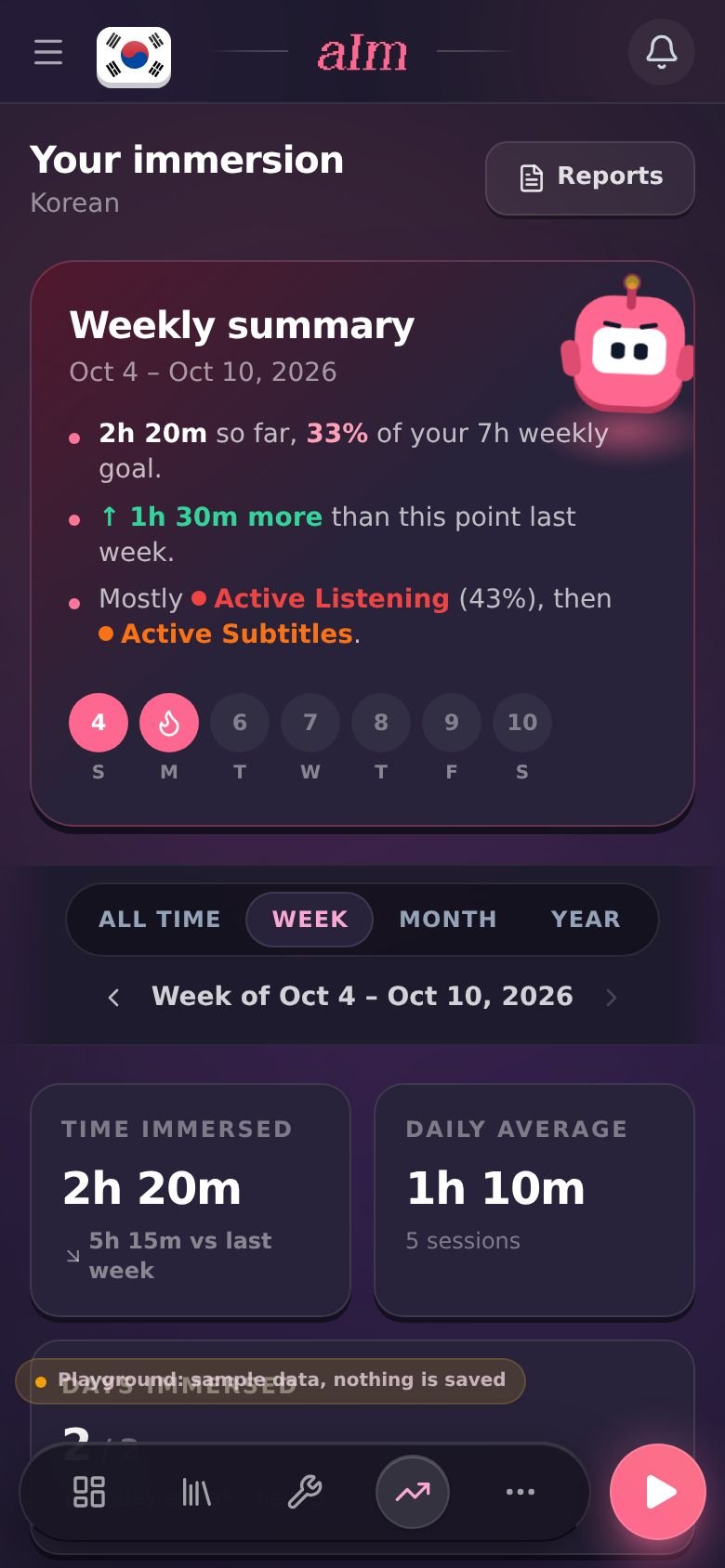
Record each session as it happens: which of the nine activities, the actual content (the channel and the video title, not just "YouTube"), the minutes, and how much you understood. Once a week, look at the days you showed up, then whether comprehension is rising, then the mix, then the total.
If you're learning both varieties, tag each session Brazil or Portugal so you can see how your hours split. See how to track your immersion for the full method.
Where Immersed fits
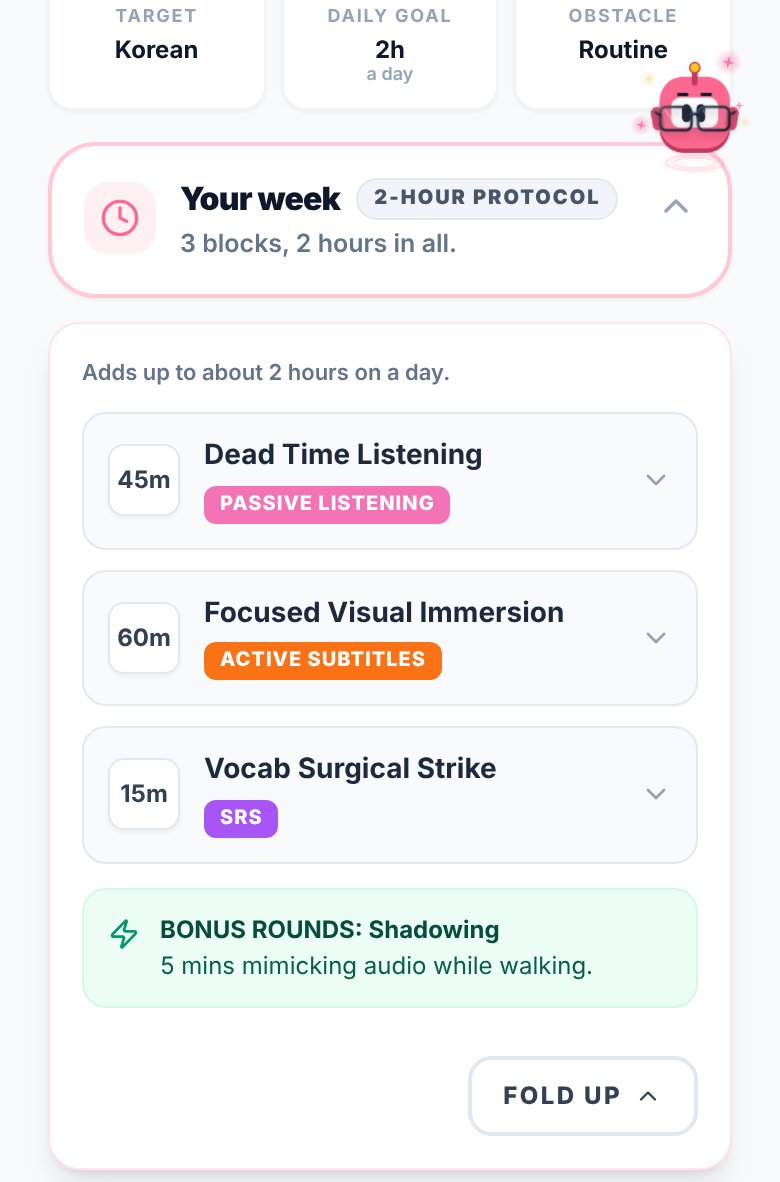
Immersed is a language immersion tracker and planner. It turns immersion into something you can see, plan and keep: a free plan built from your answers, a daily timeline for the shows, podcasts and books you learn from, and reports of your hours.
The blueprint is free with no account (it asks for your name and email). For Portuguese it gives you a plan for your day, the Hidden time where Portuguese fits, the hand-picked five-tool Toolkit above, a few platforms with up to ten real picks, and the Foundations stage of the Fluency Checklist. The listening games (Numbers, Time, Years, Colors, Animals, Fruits) are free in Portuguese with all-time leaderboards; their voice is Brazilian.
Immersed Pro ($9.99 a month, or $60 a year with a 7-day free week) adds the timeline, sessions across the nine activities with comprehension ratings, reports by activity, and Discover, a feed of Portuguese creators and podcasts where scrolling logs itself. The Pro Library has a Region filter, Brazil or Portugal, so you only see picks in your variety. Immersed never reads your viewing history; a session starts when you press play. Build your free Portuguese blueprint.
FAQ
Questions people ask.
Should I learn Brazilian or European Portuguese?+
Learn the one where your people, plans or favourite content are. With no preference, Brazilian Portuguese has far more content and learner material. Stick with one for your first few hundred hours; the other is easy to add once you understand the first.
How long does it take to learn Portuguese through immersion?+
The Foreign Service Institute puts Portuguese in Category I: 24 weeks, or 552 class hours, for its students to reach professional working proficiency, and roughly 960 hours with their self-study. At two hours a day that's about 16 months. Spanish speakers usually go faster.
Can Brazilians and Portuguese understand each other?+
Yes. They write almost the same and are mutually intelligible, though Brazilians often find European Portuguese speech hard at first because of its reduced vowels. As a learner, the difference matters most for listening, which is why you pick one to start.
What should I watch to learn Brazilian Portuguese?+
Start with learner channels like Português com Marcia Macedo, Vou Aprender Português and Speaking Brazilian. Then native YouTube such as Manual do Mundo and Nerdologia, Brazilian series on Netflix with Portuguese subtitles, and talk shows like Roda Viva once you're advanced.
What are good resources for European Portuguese immersion?+
Portuguese With Leo on YouTube, Practice Portuguese, Uca Teaches Portuguese and Portuguese Lab Podcast for learners; then Euronews em Português, Observador and its podcasts, and José Hermano Saraiva's history documentaries.
Is Portuguese easy if I already speak Spanish?+
Reading will feel easy almost at once. Listening takes longer, because Portuguese has nasal vowels and, in Portugal, swallowed ones. Spend most of your early hours listening so you don't speak Spanish with Portuguese words.