A book by Ade
The Immersed Handbook
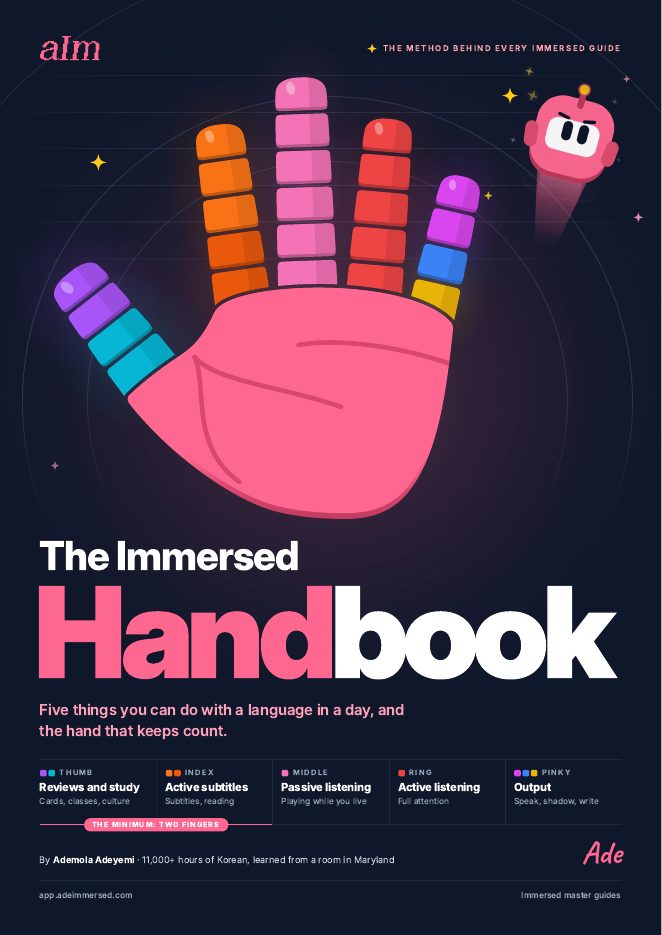
Five things you can do with a language in a day, and the hand that keeps count.
It's the most important guide on language learning I've ever written. It's still in revision, and I'm really happy with it. The first pages are done, so you can read them now.
Look at your hand
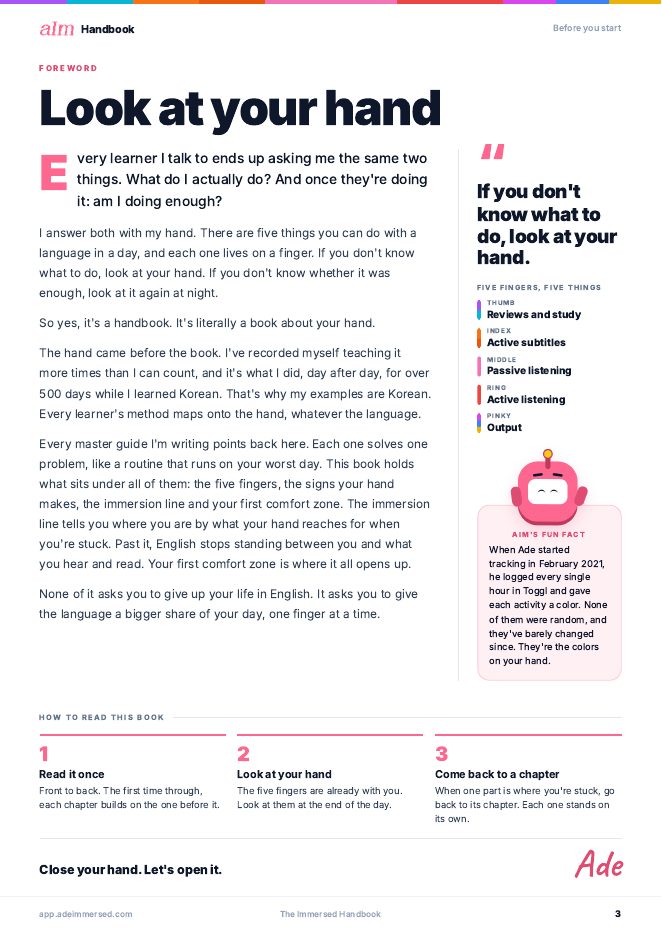
Every learner I talk to ends up asking me the same two things. What do I actually do? And once they're doing it: am I doing enough?
I answer both with my hand. There are five things you can do with a language in a day, and each one lives on a finger. If you don't know what to do, look at your hand. If you don't know whether it was enough, look at it again at night.
So yes, it's a handbook. It's literally a book about your hand.
Five fingers, five things
The minimum is two fingers. The colours are the ones in your Immersed timeline.
Thumb
Reviews and study
Cards, classes, culture
Index
Active subtitles
Subtitles, reading
Middle
Passive listening
Playing while you live
Ring
Active listening
Full attention
Pinky
Output
Speak, shadow, write
What you get today
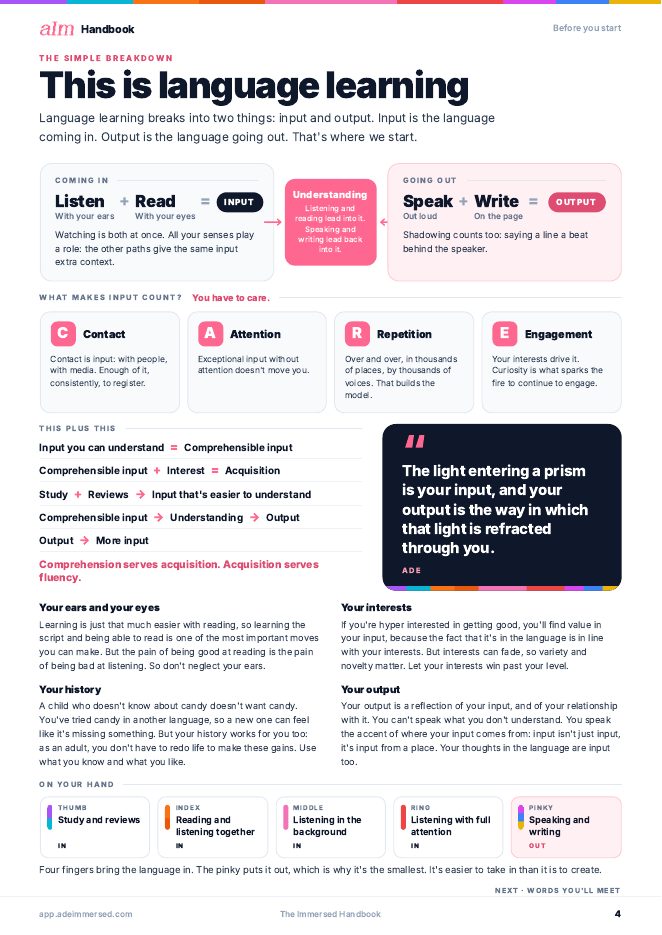
The cover, the contents, the foreword, the simple breakdown of input and output, and the words you'll meet. It's a gift, no ask.
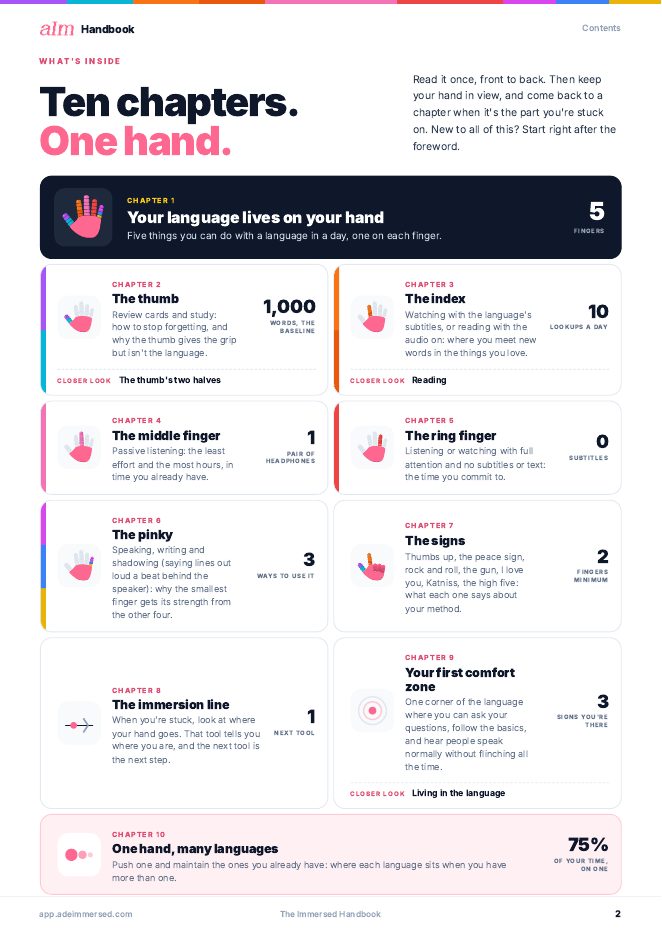
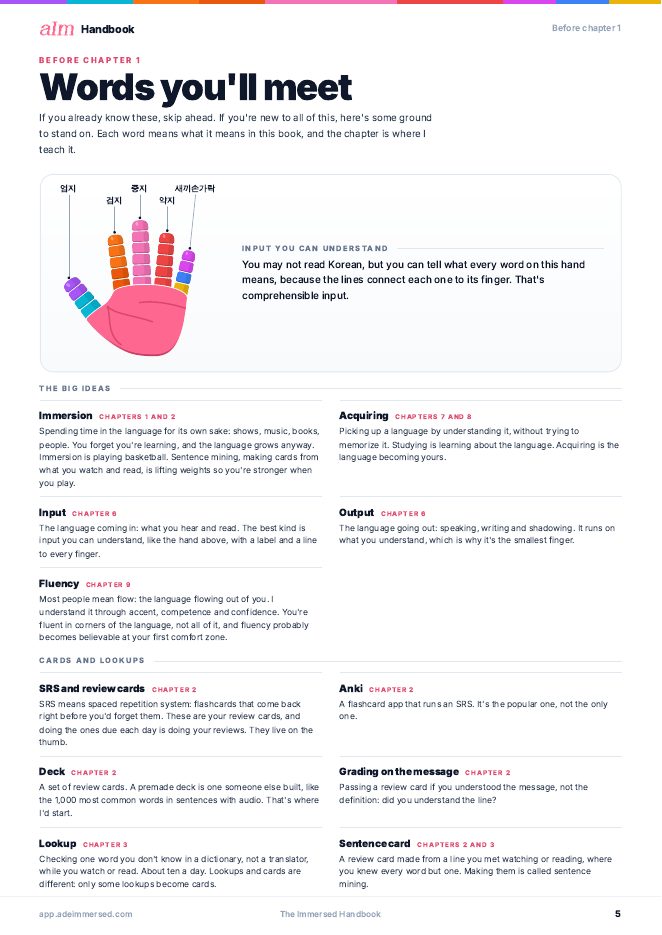
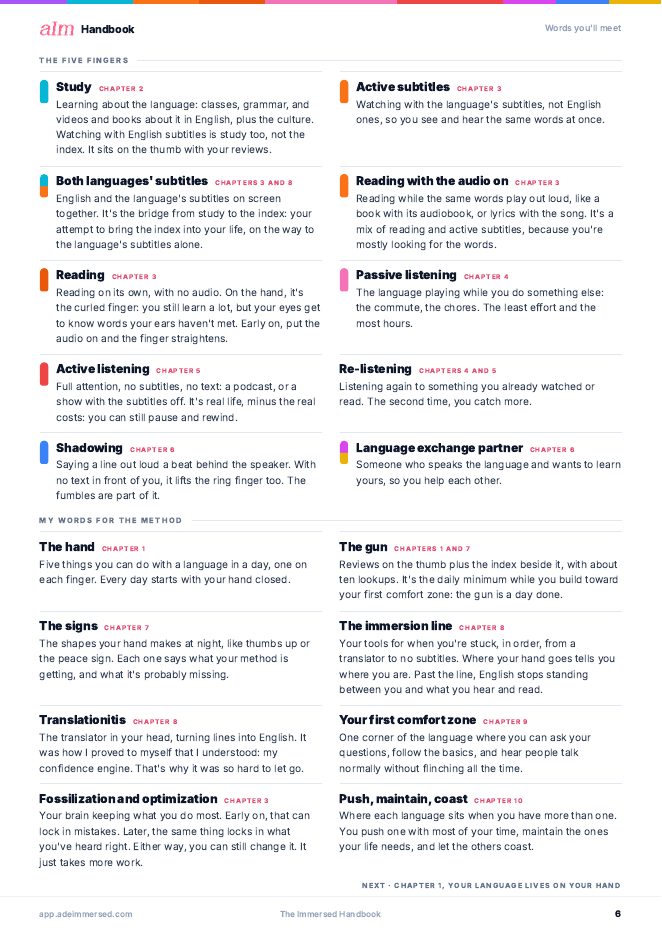
Ten chapters. One hand.
Read it once, front to back. Then keep your hand in view, and come back to a chapter when it's the part you're stuck on.
- 1
Your language lives on your hand
Five things you can do with a language in a day, one on each finger.
- 2
The thumb
Review cards and study: how to stop forgetting, and why the thumb gives the grip but isn't the language.
- 3
The index
Watching with the language's subtitles, or reading with the audio on: where you meet new words in the things you love.
- 4
The middle finger
Passive listening: the least effort and the most hours, in time you already have.
- 5
The ring finger
Listening or watching with full attention and no subtitles or text: the time you commit to.
- 6
The pinky
Speaking, writing and shadowing: why the smallest finger gets its strength from the other four.
- 7
The signs
Thumbs up, the peace sign, rock and roll, the gun, I love you, Katniss, the high five: what each one says about your method.
- 8
The immersion line
When you're stuck, look at where your hand goes. That tool tells you where you are, and the next tool is the next step.
- 9
Your first comfort zone
One corner of the language where you can ask your questions, follow the basics, and hear people speak normally without flinching all the time.
- 10
One hand, many languages
Push one and maintain the ones you already have: where each language sits when you have more than one.
Why my examples are Korean
The hand came before the book. I've recorded myself teaching it more times than I can count, and it's what I did, day after day, for over 500 days while I learned Korean.
I've put in 11,000+ hours of Korean, learned from a room in Maryland. Every learner's method maps onto the hand, whatever the language.
None of it asks you to give up your life in English. It asks you to give the language a bigger share of your day, one finger at a time.
Close your hand. Let's open it. Ade
Read the first pages
They go to your inbox, and you're on the list for the full book.